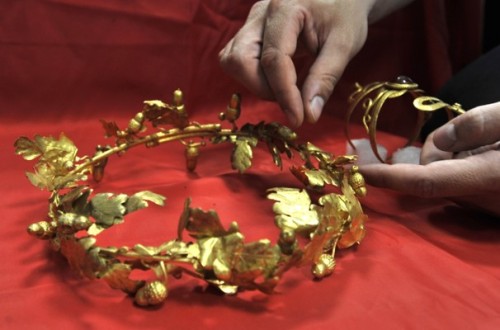
Earlier in June two men were arrested for allegedly smuggling an ancient gold wreath and armband out of the country:
The suspects were stopped by highway police near the village of Asprovalta, some 40 kilometers (25 miles) east of Thessaloniki late Thursday. Officers, who were working on a tip that the house painter might be trafficking in antiquities, found the 4th century B.C. artifacts in a shoebox under the passenger seat.
The wreath was a rare and valuable find, said Nikos Dimitriadis, head of the Thessaloniki police antiquities theft section.
“It is a product of an illegal excavation from a Macedonian grave, according to archaeologists (who examined it),” he said.
There are reports that between two and six individuals have been arrested in connection with the theft of 18 Chinese objects from the Fitzwilliam Museum in Cambridge. The theft was the subject of BBC's Crimewatch Tuesday:
The stolen pieces had been given as gifts or bequests to the museum, with some experts estimating the artifacts to be worth approximately £18 million (about $28.7 million Cdn). None of the artifacts has been recovered.
Police sought help from the public through a segment on the BBC-TV program Crimewatch on Tuesday evening. The show aired closed-circuit camera footage of four suspects sought in conjunction with the robbery.
As Dick Ellis explained in an interview last week, these thieves probably saw the booming trade in Chinese artworks, and may not have understood how difficult an eventual sale would be. Much in the same way similar objects were stolen from the Durham museum.
Noah Charney speculated last week that the stolen objects will be "smuggled [to China] . . . for in China the general rules about not purchasing art without performing Due Diligence and checking stolen art databases do not apply. Provenance is far less of an issue, sometimes for cultural reasons, but also for practical ones–Internet black-outs mean that many in China could not check stolen art databases, even if they were inclined to do so." I'm not sure that will be the case.
The Chinese have—on paper at least—the most regulated art market in the world, with a tiered series of regulation. It is one of the only sets of regulations which puts direct regulation in the art market, at the point of sale. Are there problems and corruption? Perhaps. But what art market—whether its in Rome, Paris, London, or New York is not corrupt?
In 2002, the Standing Committee of the National People’s Congress passed the Law on the Protection of Cultural Relics. The 2002 Law legalizes private transactions involving cultural relics in five circumstances, (1) legal inheritance or gift; (2) purchase from cultural relics shops; (3) purchase from cultural relics auction enterprises; (4) exchanges or transfers between individual citizens; and (5) other methods authorized by the central government.
Many of these transactions take place at officially sanctioned cultural relics shops and auction enterprises; and the 2002 Law prohibits a cultural relic shop from running an auction and vice versa.
Under Article 58, the government may buy any cultural relic submitted to a mandatory inspection before sale pursuant to Article 56. During this mandatory inspection, under Article 56, the government is given a kind of right of first refusal, with the purchase price determined by the government representative. Pursuant to article 57, in the event of a sale to a private individual, a report is produced, effectively tracking the buyers and sellers of cultural objects.
This new regulatory framework seems a very aggressive strategy, and one that, if implemented effectively, could positively impact the illicit trade in China. However, implementing this strategy may be difficult and subject to corruption. And yet by recording who buys what, it may be possible not only to track the chain of title of specific cultural objects, but also to evaluate whether individuals are routinely buying and selling stolen, looted, or suspicious objects. What other nation does this routinely? Perhaps the Italian Carabinieri, but that may be it.
Many in the West have an immediate reaction to all things China. And I think that quote above does not really convey the reality of the Chinese art market. Prof. Paul Bator remarked in 1983 that China was the great under-researched area of the world when it comes to sources of heritage theft (he called it art theft). Despite s few reports, that is still the case. We can blame the Chinese for other problems perhaps, but the Chinese art market does not I think bear the collective guilt for the Fitzwilliam theft. Rather it seems to be a more homegrown set of thieves from East London.
He
Shuzhong, Protection of China’s Cultural Heritage,
5 J. Art, Antiquity & L., 19 (2000).
J. David Murphy, Plunder and preservation : cultural property law and practice in the People’s Republic of China, (1995), http://www.bcin.ca/Interface/openbcin.cgi?submit=submit&Chinkey=204154 (last visited May 2, 2012).
Andrew Jacobs, China Hunts for Art Treasures in U.S. Museums, The New York Times, December 17, 2009, http://www.nytimes.com/2009/12/17/world/asia/17china.html?_r=2&hp (last visited Dec 17, 2009).
Peter Foster, China to study British Museum for looted artefacts, Telegraph.co.uk, October 19, 2009, http://www.telegraph.co.uk/news/worldnews/asia/china/6374959/China-to-study-British-Museum-for-looted-artefacts.html (last visited Oct 20, 2009).
Stolen to order? Nature Mort au Chandelier, Fernand Léger, 1922
Last week it was reported that three individuals were arrested in connection with the theft of five works from the Musée d'art Moderne in Paris. The thefts took place in 2010 and there were reports that the museums alarms had been malfunctioning for months. Well the thieves may have had a very easy time stealing the art. There are reports that the five stolen works were destroyed, and that one of the works was stolen to order:
Detectives said that while they remained sceptical about his account, they could not "totally rule out" this catastrophic scenario. The destruction of such landmark masterpieces would be a major blow to international art heritage.
The first to be arrested was a Serb known only as Vrejan T, 43, nicknamed "Spiderman" and who was detained days after last year's heist over a separate art theft from a chic Paris apartment.
Under questioning, the suspect reportedly recounted how he loosened screws in a window at the Art Deco Palais de Tokyo housing the museum, returned a few nights later to remove the frame and sliced through a padlock on an iron grille.
He had initially gone there only to steal a Léger work to order, he said, but once inside, was "surprised" when the burglary alarm failed to sound.
Being a "veritable art lover," the Serb told police he then wandered around for another hour, eluding 30 closed circuit cameras to cherry pick four other masterpieces. "He found the Modigliani the most beautiful of all," a judicial source told the JDD.
Vrejan T reportedly told investigators he had stolen the Léger for Jean-Michel C, 56, an antiques dealer with a shop called Antiquités Bastille. He was arrested in May for selling other stolen art works.
As a wise Museum Security Director once said: 'shit happens'. Lets hope this is the statement of a desperate defendant, and the paintings are still safe. This underscores the point that tracking down art thieves is a delicate proposition. They have a very big piece of collateral, in this case five important works of art. If you prosecute the thief too harshly, you run the risk of destroying what you were after. Of course the best way to prevent this destruction would have been better basic attention to security.
The three, a woman suspected of taking part in the theft and two people suspected of handling stolen goods, were arrested and charged over the robbery of the five paintings, by Henri Matisse, Pablo Picasso, Georges Braque, Ferdinand Leger and Amedeo Modigliani, and placed in custody on September 16, the official said.
A lone burglar sheared off a gate padlock and broke a window to get into the city-run Musee d'Art Moderne in the brazen operation during the night of May 19 last year.
The paintings were found to be missing just as the museum, a major tourist attraction near the Eiffel Tower, was about to open.
Paris mayor Bertrand Delanoe later said one of the museum's alarms had been "partly malfunctioning" since the end of March, and that it was still awaiting repair when the thieves struck.
Authorities said Thursday that the four Greek and two Albanian men were arrested Wednesday after police discovered a 12-meter (40-foot) tunnel blasted into the side of a mountain near the city of Kavala, 700 kilometres (435 miles) north of Athens.
The tunnel, with support columns and a construction track, was first started in 2008, according to local police, who said the suspects would be charged with illegal excavation, illegal use and possession of explosives, and violating archaeological protection laws.
Archaeological services would not comment on whether they believed there was buried gold in the area.
". . . but also the money that he can get from it".
So says an unnamed source describing the notorious Stéphane Breitwieser who stole 240 works of art, went to prison, wrote a memoir and has been arrested again in his home:
At Breitwieser's home, police discovered about 40 paintings, three sculptures, and a tapestry, French newspaper Le Parisien reports. At Breitwieser's mother's place, cops also found a landscape by a Brueghel pupil that had been stolen from a Brussels museum. Several valuable objects, including chandeliers and pocket watches, were also discovered in the pond next to Breitwieser's mother's house. In the past, she destroyed several paintings in order to protect her son, and also hid his stolen artworks along a highway, in a canal, and even in a neighbor's chicken coop.
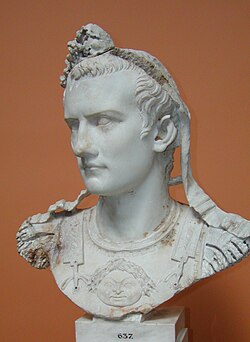
Italian police have arrested a tombarolo with an 8-foot ancient statue not far from Rome. The statue may be worth €1 million. They believe the statue may be of Caligula, and may even have been looted from Caligula's tomb, which has not been discovered. We surely won't know if this tomb or the site was the actual tomb, but if looting is destroying the archaeological record, we are losing information.
Might the record have given us information on Caligula, who may have received a bad rap from the sources which have survived antiquity? Contemporaries describe the emperor as insane, saying he appointed a horse as consul, slept with his sisters, and killed often. But these might have been claims made by his political enemies in the senate and elsewhere—perhaps not too different from today's politics. After all, how could the son of Germanicus (my favorite Roman) have been such a bad guy. Caligula only ruled from AD 37-41, before he was assassinated.
I wonder where this statue was going to be sold? The United States, the middle-East, Asia? Excavations will start to reveal the archaeology of the site where the tomb raider unearthed the massive statue.
Authorities in Turkey have discovered an "important archaeological site" while searching for looted antiquities, reports the Associated Press. The discovery was made near Milas, in western Turkey. This sarcophagus may have contained artifacts, but they have disappeared, likely lost in the illicit trade. The piece describes the tunnels:
[T]he suspects had dug two tunnels — 6 and 8 meters (yards) long, from the house and an adjacent barn, leading to the tomb that is buried some 10 meters (yards) deep.
They used sophisticated equipment to drill through the thick marble walls of the tomb and were working to remove the coffin from the underground chamber when they were detained, according to the Culture Ministry.
"I would have wished that this (archaeological find) had been discovered through our digs and not through digs conducted by a band of treasure hunters," Anatolia quoted Gunay as saying.
"This is not an ordinary treasure hunt. It is very organized and it is obvious that they received economic and scientific help," Gunay said, adding that Turkey also would investigate the suspects possible overseas links.
On Monday two pleaded guilty to stealing government property and violating the Archaeological Resources Protection Act. Both Brent Bullock and Tammy Shumway had been among those indicted during a federal investigation into looting Native American sites in the Four Corners region in the Southwest. From the AP:
Bullock, 61, sold several ancient Indian items to an undercover operative in 2007, including a blanket fragment for $2,000 and a hoe-like tool for $500, according to court documents. He also offered to sell several ceramic figurines taken from U.S. Bureau of Land Management land.
Bullock said he wanted to sell the items because he was in debt, according to a search warrant affidavit.
Investigators said Bullock acknowledged to the informant that the items came from public land in Utah but filled out paperwork saying they were from private land in Colorado.
Shumway, who introduced Bullock to the informant, was charged because the 40-year-old woman aided and abetted the deals and signed a falsified paper about the items' origin as a witness, federal officials said.
In U.S. District Court on Monday, Bullock and Shumway acknowledged they knew the items had been illegally dug up from public land in Utah. As part of a plea deal, they each pleaded guilty to one count of trafficking in stolen artifacts and theft of government property. Prosecutors agreed to seek a reduced sentence.
A couple points which might not be evident from some of the coverage of these plea deals. First, sentencing will occur in July; and the AP piece notes the maximum sentence is 12 years in prison. Neither of these defendants will likely receive anything close to the statutory maximum. That is because when a defendant enters into a plea deal, they do so in most cases to achieve a recommendation from prosecutors on sentencing; which will often fall far below the maximum sentences. This should not be construed as authorities in the United States not taking these crimes seriously—rather a reflection of the general criminal procedures when plea agreements are reached.
Second, Tammy Shumway is the widow of Earl Shumway, a notorious antiquities looter. Shumway became a national figure in the 1980's, who boasted that he began looting at three years old with his father. He sold a large collection of over thirty prehistoric baskets and sold them for a great deal. Though he was prosecuted for selling those baskets, he cooperated with authorities and only received probation. He went right back to looting, using a helicopter and even lookouts to avoid authorities. He boasted to the media that he could never be apprehended. Though he was not caught in the act of looting, authorities did secure a conviction using DNA evidence found on Mountain Dew soda cans he left in the areas he looted. In 1995 he received a 5-year prison sentence which sent a message that Federal agents and prosecutors took this kind of crime seriously.
Police in Cyprus have detained ten people over the weekend and are looking for five more after the discovery of an international antiquities-smuggling ring believed to be the largest such discovery in Cyprus's history. The objects seized may be worth more than 11m euros, and include pottery, coins, figurines, some of which may be 4,000 years old. Many of the objects may have originated elsewhere, and authorities now are attempting to determine the origins of many of the objects. The BBC points out that Cyprus was an important crossroads in the ancient Mediterranean, with armies and merchants from Egypt, the Roman Empire, Persia, and others. This may make it difficult to trace the origin of these objects, many of which could plausibly have originated from dozens of modern-day nations. The smugglers of course were likely to have disguised or destroyed any evidence of the history of these objects.
The AP reported yesterday that charges have been filed against nine employees of the Drouot auction house. French authorities last week found a stolen work by Gustave Courbet.
An auctioneer and eight commission agents were given preliminary charges, including ''organized theft,'' the prosecutor's office said. Three others detained last week in the police raids on Drouot, its warehouses and homes of employees were released with no charges filed against them. When the bust was announced last week, there was initial confusion about which Courbet work had been recovered. The painting -- stolen several years ago from a collection whose owner had recently died -- was not clearly identified, and the heir had confused it with another work, an official close to the inquiry said. He spoke on condition of anonymity because the case is ongoing. Police initially identified the recovered Courbet work as ''La Vague'' (The Wave), worth euro900,000 ($1.3 million), but officials said Monday it was actually ''Paysage marin sous un ciel d'orage'' (Marine Landscape Under a Stormy Sky), worth about euro100,000. The stolen Courbet -- one of several paintings by the convention-smashing realist master with a stormy ocean theme -- was found at the home of one of the commission agents being investigated. Other pieces recovered in the sweep included artworks, frames and furniture. Under French law, preliminary charges give the judge more time to investigate and determine whether to send the case to trial. Three commission agents were jailed in the case, with the prosecutor's office accusing them of deep involvement in thefts dating back to 2001. The auctioneer was released pending the investigation with the stipulation that he stop hosting sales.
In more news which seems to reflect poorly on the French art trade, the AP is reporting that 12 people have been "detained" from the Hotel Druout auction house in Paris. Police found a stolen Courbet painting, the Wave, which was stolen in 2004.
The thieves who stole two paintings from the Roerich Museum in Manhattan were arrested last week as they tried to sell one of the stolen works to an undercover cop at a Starbucks:
On Sept. 3, Ryjenko and Croussouloudis -- carrying the painting in a blue paper shopping bag -- traveled to a Lower East Side Starbucks to meet with the detective, police said.
While Ryjenko waited outside, Croussouloudis met with the phony collector and asked for $20,000 for the painting. She even warned him that the work of art had been stolen and that he would be unable to freely display it in his gallery, police said.
The cop then asked her to come with him to his gallery where he would give her the money. As she and Ryjenko walked with him up Allen Street, they were arrested.
A law-enforcement source said the couple denied having stolen the painting.
The Utah antiquities investigation may lead to other arrests. So say Federal authorities in an article for the AP. There is some really damning evidence (already) in some of the search warrant affidavits, and it confirms what many have long speculated:
Federal authorities in charge of the nation's biggest bust of artifact looting and grave-robbing are targeting more suspects ranging from those who do the digging to wealthy buyers in the lucrative black market of ancient Southwest relics.
Twenty-five people have already been charged after a long-running sting operation involving a bounty of artifacts taken from federal and tribal lands in the Four Corners region.
More arrests are likely, according to federal officials. Among the next targets could be wealthy collectors who fuel the underground trade.
"It's fair to say the investigation is looking at all levels, from diggers and dealers to high-end collectors," said Carlie Christensen, an assistant U.S. attorney for Utah.
The case was the first to deeply penetrate the murky world of American Indian artifacts trafficking, relying on a well-connected artifacts dealer-turned-undercover operative.
The man was equipped to provide federal agents with wireless video feeds from homes and shops where he wheeled and dealed over artifacts, ultimately spending more than $335,000 on bowls, stone pipes, sandals, jars, pendants, necklaces and other items.
He was paid $224,000 for the undercover work over 2 1/2 years, according to search warrant affidavits describing his work.
The informant gave federal officials a rare insider's view of the illegal artifacts trade, recording a parade of suspects as they described their methods in astonishing frankness.
They discussed digging in camouflage or by moonlight, knowing when a park ranger takes his days off, and looting in spring when the dirt softens up and before the heat of summer.
One suspect said he scouted for ruins in a fly-over and followed up with a 10-mile hike. Another dug fresh holes on his property in case "someone comes asking" about where his artifacts came from, the documents say. Yet another boasted that in a 1986 raid, federal agents took 32 of his pots but overlooked a hidden safe and the most damning evidence — a ledger of a lifetime of trading that named people he dealt with.
Some pretty remarkable nuggets, and this is probably what the agents had intended to do all along, arrest or indict a large number of the lower-level looters and dealers in the hopes that they may implicate other individuals higher up the supply chain. It should be interesting to see where the investigation arrives, perhaps even implicating the sale of objects from other nations?
An Arkansas couple has been sentenced in federal court for looting stone tools, arrowheads and other objects from sites near the Buffalo National River national park. After a plea agreement, William Graves was sentenced to six months in federal prison, with one year of probation for a felony count of violating the Archaeological Resources Protection Act of 1979; his wife was sentenced to a year of probation for a misdemeanor violation. They must also pay $4,613 in restitution. Why does looting continue? These are not particularly stiff penatlties, particularly when compared to other kinds of theft, and the monetary value placed on these objects is not really high, nor is there enough attention paid to the archaeological record which is distorted when these objects are removed.
The couple, William A. Graves and Misty Graves, were caught near the site in January, after park rangers were alerted to recent looting at a well-known archeological site in the upper district of the park, according to a news release from the National Park Service.
At the time of the arrest, William Graves was carrying digging tools and wearing boots that matched impressions found near the looting site, the park service said, while his wife was found with their vehicle at the trailhead in possession of several artifacts and a pick.
A search warrant at the Graves’ home turned up additional tools and evidence, the release said. After a six-month investigation, the Graves were indicted in federal court. William Graves, who subsequently admitted digging in the park, also turned in “71 stone tools, projectile points, or other artifacts” he said came from the site, authorities said.
An Italian appeals court this week upheld the conviction of Italian art dealer/smuggler Giacomo Medici according to a report by Steve Scherer for Bloomberg. Medici had been convicted of conspiracy to traffic in antiquities in 2004 and sentenced to a 10-year term. It seems to be a very stiff sentence when compared to most art and antiquities crimes. The Appeals court in Rome upheld the conviction and set the sentence at eight years, while upholding a 10 million-euro fine. Italian Prosecutor Paolo Ferri told the LA Times that this was a "very hard sentence. This is the first time in Italy that this type of crime has been given such a high punishment."
This is the most recent culmination of the 1995 raid on the Medici warehouse in Switzerland which uncovered objects, polaroids, and otherevidence which has resulted in a number of repatriations from museums all over the world, but particularly North American museums. Here of course is Medici, triumphantly posed next to one of his most notorious objects, the Euphronios Krater, when it was on display at the Met in New York.
This now leaves Marion True, former curator of antiquities at the Getty, whose criminal prosecution is currently ongoing. One question worth asking is, where are the other dealers, tombaroli, and museum staff? Where were those able to elude prosecution, not just in Italy, but in the United States as well.
I'll have much more on this, and Italy's cultural policy next week in light of Francesco Rutelli's comments at last Saturday's ARCA conference in Amelia Italy, including his thoughts on what other objects need to be returned, why they were sent back, and his thoughts on objects which had been acquired by Robin Symes.
Steven Shrader, one of the 24 individuals indicted for dealing in looted antiquities killed himself Thursday night. This comes after the suicide of another man in connection with the case. The sad news should increase the criticism by two Utah senators who have asked for a Congressional investigation into the tactics used by Federal Authorities.
The Salt Lake Tribune reports:
News of a second death in the antiquities crackdown surprised southeastern Utahns . . . . "That's tragic -- if it's the result of his concerns over his case," said Phil Mueller, a Blanding resident and Redd family friend. "I don't know -- I don't know [Shrader]. But to hear the news is certainly very tragic." Mueller added that he doesn't accept federal authorities' explanation that they needed a show of force in the raid because they believed most of the suspects could be armed. "You could walk up to any house in San Juan County," he said, "and they'd probably have a gun."of a second death in the antiquities crackdown surprised southeastern Utahns, although those contacted said they had not heard of Shrader.
These suicides are certainly tragic, and though some blame may be placed on the tactics used by federal agents, the simple truth is when you violate federal law, you are running the risk of arrest and prosecution. Digging up Native American remains is not an innocent activity one accidentally does it seems to me. And as more of the search-warrant affidavits are made public, there is more and more allegations of clear wrongdoing on the part of the indicted individuals. Patty Henetz for the SLT summarizes the recent affidavit released by federal court:
On a brisk morning last September, three men -- including a federal undercover operative -- carried shovels and rakes to an ancient Puebloan mound on public land in San Juan County. As they piled dirt onto a blue plastic tarp, out popped a skull.
Thediscovery, recorded in real time and detailed in recently released federal court papers, didn't seem to slow the men much.
Richard Bourret picked up the skull and put it back in the hole, the documents say, then he, Vern Crites and the operative, whom federal authorities call the "Source," folded the tarp and funneled the dirt back into the hole. There wasn't quite enough to cover the damage.
Crites lamented a lost opportunity, saying he "wished that fella had still been intact, the skeleton, I mean."
Brendan Borrell has an interesting piece for Scientific American following up on the number of arrests which focused on the theft of Native American objects from the four corners region, which has been described as a massive outdoor museum. Pictured here are the Butler Wash ruins near Blanding.
Two Utah senators, Orrin Hatch and Bob Bennett have both called on Congress to investigate the actions of the federal agents surrounding the arrests, which led to one apparent suicide, the raid of one home for 10 hours, involving 300 agents and a SWAT team.
One of those arrested, Brent Bullock tells Scientific American, "I’m guilty of arrowhead collecting, as is two-thirds of this town.” It seems he:
[T]ried to sell a blanket fragment, fireboard, and stone hoe known as a Tchamahia. In a phone interview, he said that, like Lacy, he was also asked to identify the spot where the items were obtained and he subsequently signed a Letter of Provenance. He says agents later showed up at his house, placed his arrowheads and other artifacts in bags, and photographed them although they did not have permission to seize his or any other artifacts yet. “They ripped this place apart,” he says. “This town is all stirred up.”
Criminal penalties may help to ease the taking of objects from these sites, but they also create a great deal of anger and resentment. I think rather than just focusing on the arrests and the backlash, we should also pay attention to much of the education and outreach being conducted. Were all of these individuals really hardened criminals, bent on destroying archaeological heritage to sell antiquities? I'm sure some may have been, but the investigation seems to be failing spectacularly at convincing at least some local residents the importance of heritage preservation. What will happen when the attention of federal authorities goes elsewhere? Criminal penalties are important, and certainly justified in many cases. But I would like the attention being paid to this controversy to focus on some practical initiatives that can do a lot of good before looting and destruction take place. Take a few examples such as: volunteer programs, initiatives such as the Comb Ridge project, and continued recruitment of site stewards.
The LA Times has more on the 24 indictments unsealed yesterday by federal authorities. The individuals were charged both under the Native American Graves Protection and Repatriation Act and the Archaeological Resources Protection Act. The press release is here, which has the names of the defendants, and some of the arrest warrants. I find it noteworthy for at least two reasons.
First, this seems to be the familiar problem with heritage preservation just about anywhere in the world—helping local residents understand the importance of preserving objects—and not removing them. In the case of thisarea, there are artifacts, pots, baskets, textiles, axe-heads and other objects often are well-preserved by the dry air, and in some cases aren't even buried. I think these arrests are a welcome development, but they aren't going to be the best or only solution. These extensive criminal investigations help raise the profile of the problem, but as I've argued elsewhere; they aren't a solution. These elaborate criminal investigations are expensive, and require a great deal of resources. I'm not sure either that we can guarantee that these will continue. I'd like to see these arrests followed by some outreach explaining to the residents of these and other rural communities why these objects need to remain where they are, so they can be preserved for future generations.
Southwest residents have been scooping up artifacts for generations. Since the early 20th century, settlers were even encouraged to dig up arrowheads, pottery and other remains. In the 1920s the University of Utah paid Blanding residents $2 per ancient pot.
Federal authorities estimate that 90% of the 20,000 archaeological sites in San Juan County, where Blanding is located, have been plundered.
According to a search warrant affidavit, the FBI and Bureau of Land Management in October 2006 developed "a major dealer of archaeological artifacts" as a source who would help them unravel the informal network of pot hunters profiting off the land's history. Authorities wired the dealer to record the transactions.
Second, the Secretary of the Interior Ken Salazer was at the news conference, in what seems to be a high-profile attempt to highlight how seriously federal authorities are taking the looting of Native American sites. These charges arose as part of a two-year investigation. This indicates a dramatic departure from one of the final acts of the Bush administration, which was to pardon a Utah man for stealing objects from Native American territory.
"It is this comity of interests and mutual respect among nations . . . that warrants granting Spain's motions to vacate the Mercedes's arrest and to dismiss Odyssey's amended complaint". So concludes US Magistrate Judge Mark Pizzo yesterday in Odyssey Marine Exploration, Inc. v. The Unidentified Shipwrecked Vessel.
Odyssey Marine has lost in its bid to petition a US court for ownership of the coins, and Spain has prevailed—for now—in its suit to regain half a million gold and silver coins from Odyssey Marine Exploration which recovered them from a wreck in the Atlantic Ocean. The recovery of the coins, thought to be worth as much as $500 million was announced, though the location of the wreck, and information about the wreck was kept secret. In response Spain filed suit, and seized some of Odyssey's other vessels. UNESCO condemned the recovery, and much has been written and discussed about this recovery, considered perhaps the richest haul ever recovered from a wreck.
In the judgment which I've embedded below, the District Court held it lacked jurisdiction over the dispute and the property should be returned to Spain. Though Odyssey Marine attempted to hide the true identity of the wreck, initially code-naming the wreck the Black Swan, the court held that there was enough information to conclude the coins came from the "Nuestra Senora de las Mercedes", a warship which was carrying treasure back from Peru when it was sunk by the British off the Spanish coast in 1804. Spain, soon declared war on Great Britain, a point which may be lost in all this talk of the treasure. This treasure was an important piece of heritage, and all the talk of Odyssey's share prices, and the rich treasure haul shouldn't distract us from why these objects are protected, and why Spain fought so vigorously to have them declared the owner.
So these coins may be destined for Spain, finally, even though these coins were initially taken from Peru, which also asserted an interest. This has been a protracted dispute, and one that may indeed continue at the appellate level. It will be interesting as well to see how much continued involvement Peru has with the appeals process, or if Spain and Peru can come to an agreement about what can or should be done with the objects.
Spain's Culture Minister Angeles Gonzalez-Sinde is quoted by the BBC, calling the decision "a very important precedent for all future undersea discoveries". Gregg Stemm, CEO of Odyssey Marine said "I'm confident that ultimately the judge or the appellate court will see the legal and evidentiary flaws in Spain's claim, and we'll be back to argue the merits of the case."
But for now, US Magistrate Judge Mark Pizzo has the final word, concluding his recommendation, "More than two hundred years have passed since the Mercedes exploded. Her place of rest and all those who perished with her that fateful day remained undisturbed for centuries - until recently. International law recognizes the solemnity of their memorial, and Spain's sovereign interests in preserving it."
For more on the company this older piece from Voice of America is pretty interesting. This suit is really about the continued viability of this kind of business, and the perils of doing so without the support of organizations like UNESCO or other nations of origin:
The suspects were stopped by highway police near the village of Asprovalta, some 40 kilometers (25 miles) east of Thessaloniki late Thursday. Officers, who were working on a tip that the house painter might be trafficking in antiquities, found the 4th century B.C. artifacts in a shoebox under the passenger seat. The wreath was a rare and valuable find, said Nikos Dimitriadis, head of the Thessaloniki police antiquities theft section. “It is a product of an illegal excavation from a Macedonian grave, according to archaeologists (who examined it),” he said.




![[medici_sarpedon.jpg]](https://blogger.googleusercontent.com/img/b/R29vZ2xl/AVvXsEh2qvCeoz1T7qoun85NMCcrPMRuB-sUG3U7QaE058Lufbqm88-AnM6Po_NMofdBWrFoS5lEzTiEIv0QB3iNSxlKHzdPrWXAXFH-Ux984kLuHwbbDbkn0_60NEHAKWp1o2Wn3djD/s1600/medici_sarpedon.jpg)


