Showing posts with label Forgery. Show all posts
Showing posts with label Forgery. Show all posts


Apr 1, 2012
Landis and Forgery at the University of Cincinatti
 |
| A forged work by Mark Landis |
Lisa Cornwell writing for the AP:
Landis creates works in oil, watercolor, pastels, chalk, ink and pencil, making most of his copies from museum or auction catalogs that provide dimensions and information on the originals. He sometimes bestows gifts under different names, such as the Father Arthur Scott alias used at Hilliard. In that case, he told officials that his dead mother had left works including Curran's oil-on-wood painting "Three Women" and that he was donating it in her memory. . . . The Faux Real show will run through May 20 at the Dorothy W. and C. Lawson Reed Jr. Gallery. It depicts famous art forgers, details of how Landis made some donations and ways of detecting fakes. Visitors can view some works under ultraviolet light that causes sections to glow if they contain contemporary ingredients. Art experts say not accepting payment for his forgeries has helped keep Landis from being charged with a crime. Museum officials say forgeries can hurt their reputation and cost time and money researching suspected fraud.He presents a challenge for prosecutors and the small museums he donates the works to. But the attention paid to him now will hopefully prevent future museums from accepting more forgeries. The exhibition will run through May. ARCA offered advice with respect to the possible ways the law regulates (or to be more accurate has difficulty regulating) these forgeries and donations.
Mar 7, 2012
Germany's Master Art Forger
 |
| A forgery of a work by Molzahn |
Beltracchi and three accomplices were sentenced after just nine days at the Cologne District Court, with the defendants receiving shorter sentences in exchange for full confessions. But in a SPIEGEL interview the 61-year-old has now admitted to creating phoney works by "about 50" different artists. Speaking to the media for the first time since he was sentenced, Beltracchi refused to name the exact number of paintings he forged throughout his career, which he began in the 1970s by creating "unpainted works by old masters, and later Jugendstil and Expressionists" and selling them at flea markets. But during the interview with SPIEGEL, Beltracchi said that due to high demand, he could have easily put "1,000 or 2,000" forgeries on the art market.
- Ringleader Reveals He Faked Many More Works, Spiegel Online, March 5, 2012, http://www.spiegel.de/international/germany/0,1518,819409,00.html (last visited Mar 8, 2012).
Jan 27, 2012
Footnotes
 |
| "Le Marché" |
- A work by Camille Pissarro, stolen from France in 1981 is on its way back after a United States forfeiture proceeding (previous discussion here).
- Princeton has announced the return of six antiquities with questionable histories to Italy.
- Maya remains and objects were discovered in Belize during a construction project.
- An investment art fraud scheme has been uncovered in Australia.
- Can nuclear physics determine whether a piece of art is genuine?
- Thieves have stolen 2 works of art from an Olympia, Washington art gallery by breaking and entering through a skylight.
- UNESCO has threatened to revoke world heritage status for Seville because of a decision to build a new 40-story building.
Jun 8, 2011
Forging Folk Art
 |
| The late Clementine Hunter, at home in Louisiana |
Over the past four decades, Mr. Toye and his wife have been formally accused three times of having sold or trying to sell fakes, most often imitations of paintings by the folk artist Clementine Hunter, whose work Mr. Toye professes to despise. But this is the first time he has been fully prosecuted.
The conspiracy being considered is an odd one, involving Mr. Toye’s British-born wife, Beryl, and a dealer in New Orleans named Robert E. Lucky Jr., who is alleged to have sold the Toye Hunters to customers around the country and in some cases to have resold them after they were returned by disgruntled purchasers.
There is a good deal of bad blood. In a floridly reproachful letter in 2005, Ms. Toye told Mr. Lucky that if he were to end up in jail, “it will be with my blessing and my boot up your rear end.” Yet Mr. Lucky and Ms. Toye are scheduled to go on trial in August. (Ms. Toye’s lawyer said she continues to maintain her innocence.)
- Campbell Robertson, “William Toye Pleads Guilty to Fraud,” The New York Times, June 7, 2011, sec. U.S., http://www.nytimes.com/2011/06/08/us/08forgery.html.
- “Baton Rouge man admits Clementine Hunter forgery | NOLA.com”, n.d., http://www.nola.com/crime/index.ssf/2011/06/baton_rouge_man_admits_clement.html.
Jan 13, 2011
Wild Story of A Forger who Donates his Forgeries
Randy Kennedy has a super article (following an earlier report in the Art Newspaper) discussing a man named Mark Landis who forges works of art and donates the forgeries to art museums all over America. He may have been doing this for as many as twenty years.
That is a pretty remarkable thing to do, even in the art trade. The lesson is clear though, we can certainly blame the forger/donor, but provenance and the history of an object must be checked, even when an object is donated.
His real name is Mark A. Landis, and he is a lifelong painter and former gallery owner. But when he paid a visit to the Paul and Lulu Hilliard University Art Museum in Lafayette, La., last September, he seemed more like a character sprung from a Southern Gothic novel.
He arrived in a big red Cadillac and introduced himself as Father Arthur Scott. Mark Tullos Jr., the museum’s director, remembers that he was dressed “in black slacks, a black jacket, a black shirt with the clerical collar and he was wearing a Jesuit pin on his lapel.” Partly because he was a man of the cloth and partly because he was bearing a generous gift — a small painting by the American Impressionist Charles Courtney Curran, which he said he wanted to donate in memory of his mother, a Lafayette native — it was difficult not to take him at his word, Mr. Tullos said.
That is a pretty remarkable thing to do, even in the art trade. The lesson is clear though, we can certainly blame the forger/donor, but provenance and the history of an object must be checked, even when an object is donated.
- Randy Kennedy, Elusive Forger, Giving but Never Stealing, N.Y. Times (Jan. 12, 2011).
- Helen Stoilas, "Jesuit priest" donates fraudulent works, The Art Newspaper (Nov. 2010).
Aug 25, 2010
Forgery Ring Discovered in Italy
The BBC and ANSA are reporting that a forged art ring has been discovered by authorities after an 18 month investigation. The investigation was conducted by monitoring payment transfers and consulting art historians. Works recovered include forgeries of works by Matisse and Magritte. There are more than 500 counterfeit works, which may have cost buyers close to 9 million euros.
- Italy seizes counterfeit artwork, BBC, August 25, 2010, http://www.bbc.co.uk/news/world-europe-11088475 (last visited Aug 25, 2010).
Jun 18, 2010
"Maybe a Man's Name Doesn't Matter That Much"
So says Orson Welles in this clip from F for Fake. I couldn't help but think of Welles and his film when reading Martin Gayford's piece on the National Gallery in London's new exhibition "Close Examination: Fakes, Mistakes and Discoveries".

The point of this story is not that art experts are foolish. In fact, the Faun is a very clever forgery. Its brilliance in part is that there actually was a Gauguin sculpture of a faun – it’s listed in an old inventory and may still exist in a cupboard somewhere. The lesson is that now we know it’s not a Gauguin, it ceases to be part of a larger whole: Gauguin’s art. At that point, even if it is still quite an attractive statuette, it loses an enormous amount of meaning. Discovering a work is a fake is like discovering a friend has been lying to you for years.It is difficult to separate the object from the deception. Even if the faun was a terrific work of aesthetic beauty, the fraud which spawned the forgery taints that beauty in our mind—we might even resent the object the better the "fake" really is. That is not to say it cannot be a beautiful object, but it loses something by trying to trick us.
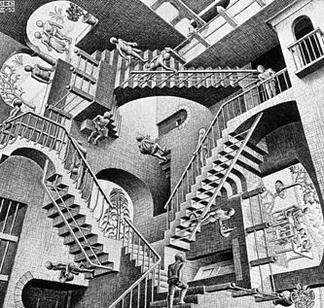 |
| Relativity, M.C. Escher, 1953 |
The bigger question is how many forgeries are exhibited in museums alongside the authentic works. When buyers and sellers and museums are not careful about the history of an object (including antiquities) we might think of them as a kind of forger as well. They may be unwitting, and fooled by a clever forger as the Art Institute of Chicago was, but when they value the object above everything, they risk becoming complicit in the forgery.
- Martin Gayford, Art forgeries: does it matter if you can't spot an original?, Telegraph.co.uk, June 17, 2010, http://www.telegraph.co.uk/culture/art/art-features/7824999/Art-forgeries-does-it-matter-if-you-cant-spot-an-original.html (last visited Jun 18, 2010).
Jun 8, 2010
Vernon Rapley Leaves the Metropolitan Police for the V&A
According to a report by the Art Newspaper, the V&A museum has hired Detective Sergeant Vernon Rapley away from Scotland Yard's art and antiques. The V&A is a massive museum, which has been difficult to safely secure in the past. Here's to hoping he can continue to improve the V&A's security. From the Art Newspaper:
He joins the museum on 21 June, to take charge of security and visitor services. Before turning to art, Rapley investigated murder, paedophilia and child abuse at the Metropolitan Police. He really got to know the V&A in 2004, when there was a spate of thefts at major London museums. The V&A was hit three times, and 38 rooms had to be shut, many for years, while security was upgraded. Supported by the V&A, the Yard set up the London Museum Security Group. Rapley even took a turn as guest curator earlier this year, when he organised a Scotland Yard-curated display at the museum on fakes and forgeries, which spotlighted the case of the Greenhalgh family from Bolton, who created objects ranging from Egyptian antiquities to modern paintings.
- V&A gets its own personal detective | The Art Newspaper, (2010), http://www.theartnewspaper.com/articles/V&A-gets-its-own-personal-detective/21044 (last visited Jun 9, 2010).
Jan 27, 2010
Barford on the Sale of Egyptian Antiquities

Barford writes:
Last night in a Luxor sidestreet on my quest for the best or the most bizarre fake artefacts, in a grubby shop I'd overlooked before, I was offered several shabtis and shabti fragments which I am pretty sure were not fakes. All the dealer offered as provenance was "here and there". After I had correctly identified the fakes he'd mixed in to test whether his customer knew his onions, he showed me a lot more. I told him that in his country there was a new law under discussion which would make merely having them in his shop punishable by up to twenty five years. I was not terribly surprised that he would not show me the "authentic scarabs" after that. Those suppliers "here and there" who sold them to him knew that these items were saleable to visiting foreigners.
The day before, I was walking across the palace site at Malkata, showing it to some colleagues, and had just replaced the cardboard "protecting" the wall paintings when a guy in a dark robe came running up. "Closed, closed, zis site he closed" he panted. He was presumably the "gafir" who was guarding this site for the SCA. Once he realised he could not make cash out of showing us the wall paintings which I'd just shown people, he then pulled out of his pocket a blue-painted sherd, the "Armarna ware" which I have seen on the Internet being sold at 300 dollars a piece and asked whether I would like to "see" it. It looked remarkably like the one I'd found there a few weeks earlier and put under a nearby bush to protect it from the sun and weather. I told him where he could put it. Interestingly this was after I had pulled out the photo-identity document issued by the SCA authorising me as an archaeologist to visit sites like this.
. . .
What is interesing about this is Malkata is littered with pottery, tonnes of it. Most of it from the Eighteenth dynasty, including some nice red wares (lovely colours), slipped ware, fine bowls, burnished ware. Yet neither of the would-be vandors had picked any of this up, they knew their market, the blue-painted pottery is coveted by western collectors and that is what they were stealing from the site to make a bit of cash. . . .
 I've had similar experiences at ancient sites as I'm sure many of you have. Pictured here is a man selling small stone 'zapotec' figurines at Monte Alban in Oaxaca Mexico this summer. I don't have the expertise required to tell if these are fakes or not. I've always assumed, as Barford did, that these locals are selling fakes.
Dec 3, 2009
César Baldaccini and the Definition of Art

During a trial this week, the brothers will attempt to argue that made these César works as a kind of imitation, but not fakes. In a report by a French magistrate, the "lack of seriousness" of several auction houses was blamed, and the French prosecutor has expressed dismay that the French art market has been "flooded" with these kinds of fakes since the artist's death in 1998.
The investigation into these forgeries began in 2001 by mistake:
Police in the south of France searching for stolen art works, including a Chagall and a Magritte, bugged several suspects in a world of high-living, cocaine-taking art lovers and dealers. They stumbled on evidence that Eric Piedoie was flooding the Côte d'Azur with fake Césars.
The appearance of so many unknown works enflamed feelings within César's family and entourage. The artist's wife Rosine Baldaccini and daughter Anna Puységur Baldaccini were disputing his inheritance with his mistress Stéphanie Busuttil. Each side accused the other of selling off works before the dispute was settled in court.
Mme Busuttil was allegedly approached by the Piedoie brothers to sign certificates of authentification for some of their works. She says she did so in good faith: a claim accepted by the prosecution.
In other words, both César's own mistress and the art critic who catalogued his work could not tell authentic "compression" sculptures from fake ones knocked off in a garage. Awkward questions therefore arise. Were César's "compression sculptures" really art? Are the Piedoie brothers con-artists or true, accidental artists themselves?
- On trial: the question of what is modern art, The Independent, December 1, 2009.
Aug 31, 2009
Recovered Picasso a Fake?
 The work of art recovered by Iraqi forces last week may be a fake. This label on the back of the work has some spelling mistakes, and indicates the Louvre sold the work to the Kuwait Museum. However the Louvre has said it has never had a Picasso.
 From the AP:
The London-based Art Loss Registry said it has no record of any paintings missing from the Kuwait National Museum, and no record of this particular painting as missing at all. The Picasso Museum in Paris and France's national museum were searching their archives for signs of the painting, which Iraqi forces seized Tuesday during a raid on a house near Hillah, about 60 miles (95 kilometers) south of Baghdad. A local judge in Hillah, Aqeel al-Janabi, said Thursday the painting will be sent to Baghdad after an investigation but refused to provide details. In a video released by the Hillah police, the man detained for trying to sell it, 33-year-old Maitham al-Issawi, said it belonged to his father, who gave it to him before his death. His father, al-Issawi, was an army officer who took part in the invasion of Kuwait, which led to the 1991 Gulf War. In the video, officers hold up the canvas, which has fold marks on the front. Police have said the painting bears Picasso's signature but would not comment further Thursday.
Aug 25, 2009
Art History is Pseudoscience?
So argues Jonathan Jones in a provocative article in the Guardian. He says "the fear of fakes does far more harm than forgery itself". Art authentication is more art than science. I've argued something similar with respect to the antiquities trade. The impetus for Jones' rebuke to art history is the recent criticism of the newfound "lost archive" of Frida Kahlo's works soon to be published by Princeton Architectural Press. Critics claim many of the works in the book are forgeries, and that causes Jones to ask if they know what they are speaking about. As he says:
Strong criticism indeed. I wonder if much of the difficulty can be traced to efforts to equate the quality of a work of art with its monetary value? Has all this money made us lose sight of the aesthetic experience? I think the best way to answer that is with Orson Welles rhetorical question in "F for Fake":
Today's art experts marshal techniques such as infrared photography to make their knowledge seem all the more scientific. This makes it harder than ever to question the voice from above. But when writing and thinking about art gets reduced to a lofty denunciation of fakes and the tedious analysis of provenance that is art scholarship's meat and drink it just fills ordinary visitors to museums with fear and insecurity. Do I actually know enough to look at this painting, you might ask yourself in front of a Rembrandt? Am I qualified to see it? The general answer implied by modern art history from Berenson to his spectroscopically equipped modern successors is a chilly "No".There is a lot of interesting food for thought here. He concludes his piece by arguing the he would rather be fooled by a few fakes than reduce art to such "pedantry". In fact he argues "many people who spend their lives studying art in depth — and pride themselves on never being taken in by fakes fooled — find it all less rewarding than the visitor to da Vinci's Last Supper whose only background reading is Dan Brown."
The consolation is that secretly the fake-busters are going mad. An academic once told me he'd been called to an antiques shop to examine a drawing by the artist he specialises in. He judged it a fake and suspected he'd been deliberately set up by one of his rivals who hoped to catch him out. What a world. It seems like a scene from a strange Nabokovian novel.
Strong criticism indeed. I wonder if much of the difficulty can be traced to efforts to equate the quality of a work of art with its monetary value? Has all this money made us lose sight of the aesthetic experience? I think the best way to answer that is with Orson Welles rhetorical question in "F for Fake":
Aug 19, 2009
German Police Uncover Massive Art Forgery Network
Another day, another report of forged art. From Deutsche Welle:
Police said they seized over 1,000 fake Alberto Giacometti bronzes and sculptures in the swoop.
The three arrested - a 59-year-old man from Frankfurt and a 61-year-old art dealer and his wife - face charges of collaborating since 2004 to sell the fake works on the international market.
Prosecutors in south-western Germany said in a statement that the sales are believed to have been worth tens of millions of dollars.
Genuine works by Giacometti have fetched sums in the millions, most notably a bronze which was purchased at an auction last year in New York for more than $27 million (19 million euros).
Prosecutors said the 61-year-old had been posing as a count who also worked as an artwork salesman. His 59-year-old colleague then pretended to be a friend of Giacometti's brother, saying that he had found the statues in a secret cache after the artist's death in 1966.
Aug 18, 2009
Forgeries of Russian avant-garde
 Konstantin Akinsha and Sylvia Hochfield report for ARTnews on the slew of Russian avant-garde paintings which were alleged to be fakes. An exhabition at the Château Museum in Tours, France was slated to exhibit 192 Russian avant-garde paintings was abruptly canceled in March, three days before its opening. Russian avant-garde is the body of modern art which was created roughly between 1890 and 1930. Pictured here is an authentic (I think) lithograph by El Lissitzky, Beat the white with the Red wedge (c. 1919).
It seems there is a slew of these forged works. Natalia Kournikova of the Kournikova Gallery in Moscow notes in the piece that "we can say that almost every artist whose prices have risen has become the victim of fake makers." Alla Rosenfeld, curator of the Norton Dodge Collection of Soviet Nonconformist Art at Rutgers University from 1992 to 2006 and former vice president of the Russian art department at Sotheby’s New York says “There are more fakes than genuine pictures”:
Fake icons and “fauxbergé” trinkets have bedeviled the art market for generations, but the escalating demand for Russian art in the last two decades has led to more ingenious abuses. For a while, “Russified” pictures—minor 19th-century European landscapes or portraits doctored to look Russian—flooded galleries and antique dealerships in Moscow and made their way to the West, appearing even at major auctions. But it has been Russian modernism—art from the first three decades of the 20th century—that has attracted the most Western collectors and consequently the most forgeries.
Hundreds of works have appeared in recent years at auction houses and in galleries all over Europe, from Munich to Madrid. These works have very sketchy provenances in which certain assertions are repeated again and again: the works are said to have come from hitherto unknown private collections or to have been smuggled to Israel by immigrants in the ’70s or to have been deaccessioned by provincial museums in the former Soviet republics—although this practice was strictly forbidden—or to have been confiscated and hidden for a half century by the former KGB (the secret police), although experts say there is not a single documented case of avant-garde works emerging from KGB vaults.
Jun 8, 2009
Art Forgery in Australia
Australia's Four Corners has aired a piece on art forgery in Australia today titled "FAKE!":
Reporter Quentin McDermott tells how up to ten per cent of art that's resold across Australia could be problematic. This crisis of confidence has led art lovers to demand that any fake unfairly traded should be destroyed or registered, to avoid it being traded again.It's a practice as old as art itself. A gifted painter takes a major artwork and reproduces it, or a variation on it. No harm in that, provided it's clear that it's not the real thing. Unfortunately some of these paintings find their way into the mainstream art market. Right now it's clear that certain individuals are prepared to place fakes for sale, making handsome profits.Alone this would be of concern, but Four Corners reporter Quentin McDermott investigates the role of gallery owners in the marketing and sale of fakes. It's now clear that, either knowingly or unknowingly, a number of high profile gallery owners have been responsible for selling paintings worth thousands of dollars, with a question mark over their authenticity.. . .
None of this is good news for art lovers. It's now clear consumers have to be very careful who they deal with, what kind of paintings they buy and who has authenticated them.This crisis of confidence has led some artists to demand any work sold under false pretences to be destroyed. Others believe there should be an art register of forged works, once they are detected, that could then be accessed by dealers and the general public."FAKE!" will be broadcast at 8.30pm on Monday 8 June on ABC1. It is replayed at 11.35pm on Tuesday 9 June.
May 28, 2009
More on Looted Antiquities on Ebay
Mike Boehm has a piece in the LA Times which does a good job following up with Charles Stanish, author of the recent piece in Archaology Magazine discussing looted antiquities on EBay which I discussed earlier here. Stanish argues that the internet is not quite the haven for looted antiquities some may have feared, but instead a substantial amount of the antiquities for sale online are likely fakes. The piece offers a counter to many of Stanish's assertions, including:
Usher Lieberman, a spokesperson with Ebay:
"We take very seriously any claims that items sold on the site aren't genuine. . . . This isn't something we're hearing a lot about."
Oscar White Muscarella, an archaeologist:
"The guy who has money and a lust for antiquities is going to buy them . . . What's going to decrease plundering is not forgeries, it's only if governments take more action."
Finally, Jerome M. Eisenberg,owner of the Royal Athena Galleries in New York is quoted in the piece:
"[A]nybody with a decent amount of intelligence isn't going to buy on EBay unless they know who they're dealing with."
Usher Lieberman, a spokesperson with Ebay:
"We take very seriously any claims that items sold on the site aren't genuine. . . . This isn't something we're hearing a lot about."
Oscar White Muscarella, an archaeologist:
"The guy who has money and a lust for antiquities is going to buy them . . . What's going to decrease plundering is not forgeries, it's only if governments take more action."
Finally, Jerome M. Eisenberg,owner of the Royal Athena Galleries in New York is quoted in the piece:
"[A]nybody with a decent amount of intelligence isn't going to buy on EBay unless they know who they're dealing with."
May 7, 2009
Fakes Uncovered in Russia

For the past 18 months, Russia’s art market has faced its worst crisis of confidence in the post-Soviet era as five volumes of “The Catalog of Fraudulent Art Works” were published, said dealers. Some experts say that fakes now comprise the majority of artworks they are asked to evaluate.
“Every month I’m asked to look at 10 paintings and nine are fakes,” said London-based Russian art dealer James Butterwick. “Many Russian collectors buy without asking competent experts. If a work is credible then it has a provenance that can be easily checked out.”
Prices have also tumbled as the financial crisis cuts collectors’ appetite for art. Combined sales at Russian art auctions in New York at Sotheby’s and Christie’s in April were about 40 percent of the volume sold in 2008.
Rosokhran-Kultura, the government’s cultural watchdog, released the latest issue of the fakes catalog last month. It contained the most expensive item sold at Christie’s November 2005 auction of Russian paintings in London. It was listed as “Odalisque,” painted in 1919 by Kustodiev.
“There’s no doubt ‘Odalisque’ is a fake, and that’s why we included it,” said the catalogue’s co-author Vladimir Roschin.
Apr 21, 2009
"What fools the curator also fools the collector"
![[image]](http://www.archaeology.org/0905/etc/thumbnails/insider2.gif) Charles Stanish, Anthropology professor at UCLA makes some great arguments in the May/June issue of Archaeology magazine about the intersection of eBay and antiquities manufacturing. The piece, "Forging Ahead: Or how I learned to stop worrying and love eBay" argues the popular auction site is not as big a problem for the looting of ancient sites as many of us might believe. Instead, a number of forgeries have begun to flood the market. It is a terrific, and frightening article. It echoes an argument I've been trying to make in recent months: that the lack of transparency in the antiquities trade is defrauding our cultural heritage. Without an accurate and impartial accounting of an object's history, how can we know for sure if an object is forged?
Charles Stanish, Anthropology professor at UCLA makes some great arguments in the May/June issue of Archaeology magazine about the intersection of eBay and antiquities manufacturing. The piece, "Forging Ahead: Or how I learned to stop worrying and love eBay" argues the popular auction site is not as big a problem for the looting of ancient sites as many of us might believe. Instead, a number of forgeries have begun to flood the market. It is a terrific, and frightening article. It echoes an argument I've been trying to make in recent months: that the lack of transparency in the antiquities trade is defrauding our cultural heritage. Without an accurate and impartial accounting of an object's history, how can we know for sure if an object is forged?Pictured here is an image from the piece of a forged Moche portrait vessel. What about other potentially forged antiquities? Stanish argues in the piece:
This isn't an isolated problem. Consider the Getty Kouros, the Bolton forgers, and the others we do not yet know about.The wealthier collector who up to now has been laughing about the naive folks who buy on eBay is in for a surprise, too: those dealers that provide private sales are some of the forgers' best customers, knowingly or otherwise. In fact, the workshops reserve their "finest" pieces for collectors using the same backdoor channels as before, but now with a much higher profit margin because they are selling fakes. As a former curator myself, I know that an embarrassingly high percentage of objects in our museums are forgeries. What fools the curator also fools the collector.From the professional's point of view, there are really three kinds of "antiquities" on eBay. About 30 percent are obvious fakes or tourist art that can be detected by looking at the pictures, even the fuzzy ones. These are easy to pick out because they are not intentional reproductions, but simple pieces manufactured for tourists and sold as such. The creators of these pieces mix up iconography and choose colors and shapes for visual effect. Such objects are clearly not ancient. Another five percent or so are probably real, while the rest are in the ambiguous category of "I would have to hold it in my hand to be able to make an informed decision." This latter category has grown fast.
One intriguing idea which struck me as I read the piece is how perhaps the demand for antiquities can be appropriately shifted to purchasing modern recreations. Rather than insist on buying an authentic "antiquity" a better model perhaps would be if buyers purchase modern recreations—which might be considered unique works of art in their own right. Many of these forgeries are similar in many respects to the "real" thing. As Stanish argues "I know . . . of one fellow who makes grass-tempered reproductions of a 2,000-year-old pottery style. Having worked on archaeological projects for years, he learned to get the grass for his fakes from ancient middens near his house. If fired properly, and if the organic residue in one of his pots were carbon dated, it would appear to be a very old piece indeed."
Jan 23, 2009
Fake and Stolen Dalis Seized
 From the BBC:
Spanish police say they have confiscated dozens of suspected fake artworks by Salvador Dali that were to be sold in the town of Estepona. More than 80 pieces were seized, 12 of which might be genuine, but are on Interpol records as having been stolen in Belgium, France and the US. A fake 10ft (3m) Dali sculpture of an elephant was priced at $1.5m (£1.1m).Police have arrested a Frenchman who transported the pieces from France for the sale. He was not identified.
The works were seized from the town of Estepona, a resort town. Reminding us again, that when you're on vacation, take extra care when purchasing art. Of the 81 seized works, 12 were thought to have been genuine. The difficulty, it seems, is with the huge number of Dali works, and purported works. From the Times:The art includes sculptures, lithographs, engravings, cutlery and textile pieces.Police also uncovered "20 certificates of authenticity" for sculptures attributed to the Spanish artist. Police said their suspicions were raised because the Frenchman had not sought special security arrangements for the show. Dali died in 1989, leaving a multi-million dollar estate, the exact value of which is difficult to calculate partly because of the widespread existence of forgeries.
Dalí, who died 20 years ago tomorrow at the age of 84, was said to have flooded the art market with thousands of fakes. He is thought to have signed as many as 35,000 blank sheets of paper to which lithographs could later be applied at any time. Some auction houses will not touch his work
Subscribe to:
Posts (Atom)
LinkWithin
