Showing posts sorted by date for query portable antiquities scheme. Sort by relevance Show all posts

Jan 6, 2012

Footnotes


Will Rome's trash follow Hadrian outside the city centuries later?

  • There are concerns over the proposed siting of a landfill near Hadrian's villa.
  • In New Orleans a man was sentenced to two years in prison and $327,000 in restitution for selling forgeries of works by Clementine Hunter.
  • Rick St. Hilaire summarizes the expected forfeiture of a painting,Cristo Portacroce Trascinato Da Un Manigoldo after the loaned work from Italy was seized, the work will be returned to the family who was dispossessed of the painting by the Nazis. 
  • Yuck: A drunk Denver woman punched, damaged and urinated near the vicinity of a $30 million Clyfford Still painting.
  • The 1866 wreck of the USS Narcissus in the mouth of Tampa Bay will become a Florida state archaeological preserve.
  • Martin Kemp found the trial of five men in connection with Leonardo da Vinci's Madonna of the Yarnwinder "deeply unsatisfying". Me too. 
  • Creativity makes people feel uneasy.
  • A Manhattan art gallery has offered a reward for stolen art.Roman spintria from London

  • The Portable Antiquities Scheme, the voluntary program for reporting objects legally found in parts of the United Kingdom, has received attention for a racy brothel coin, called a spintria, or was it a game token?
  • Finally, Tom King points out an interesting article (but no link) by Raimund Karl which describes an Austrian model of heritage management. I thought about posting a longer response and discussion, but sadly I've given up hope that the heritage advocacy sites on the interwebs can offer any useful forum for discussion. I've made a peer-reviewed case for what I think is best after looking at the law, policy and results. 

Sep 14, 2010

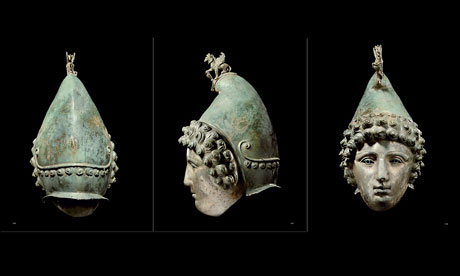
This Roman Helmet "Just" a Portable Antiquity

The Crosby Garrett Helmet, a Roman bronze cavalry parade helmet
The Crosby Garrett Roman Helmet
This stunning bronze helmet was unearthed in Crosby Garrett in Cumbria in the North of England, not too far from the Lake District.  It was discovered in 33 fragments, face down in the mud on a Roman road.

The helmet belongs to the finder and the landowner, as this helmet does not qualify under the Treasure Act.  It has been pieced together apparently by Christie's auction house which will sell the piece at an auction in October.  It might fetch as much as 300,000 GBP.  Though the piece does not qualify as treasure, it likely would be of "Waverley" quality and thus any export would be delayed to allow domestic organizations an opportunity to match any purchase price.  I've pointed out some of the benefits of the Portable Antiquities Scheme--the voluntary program which encourages the reporting of objects like this which fall below the treasure threshold. But this case presents a troubling result in many ways, as this object was cleaned for sale by Christie's.  We do not know anything about the deposits left on the helmet, or how the helmet was abandoned in pieces along an old Roman road.  Roger Bland also points out the unpalatable consequences of this find:  "It is a pity that the object was restored before there was any opportunity to examine it scientifically, as that would have given us more information about how it came to be in the ground . . .  We hope it will be possible for there to be an archaeological examination of the find spot."


  1. Maev Kennedy, “Roman cavalry helmet found with metal detector may go abroad at auction,” September 13, 2010, http://www.guardian.co.uk/culture/2010/sep/13/roman-helmet-metal-detector-cumbria.
  2. Roger Bland, “Exceptional Roman cavalry helmet discovered in Cumbria - News section,” n.d., http://www.finds.org.uk/news/stories/article/id/195.


View Larger Map

Aug 3, 2010

Footnotes

Philome Obin's "Last Supper" at the Cathedral of Sainte Trinite in Haiti

Dec 28, 2009

The Year in Cultural Policy

2009 saw a number of interesting trends in cultural heritage law and policy.  Below are a few of the year's prominent stories.  On a personal note, I am still enjoying the fellowship at Loyola in New Orleans; but still looking for a permanent position that will allow me to continue writing and thinking about cultural heritage.  But in the mean time your interest and support continues to enrich and support my work.  There is a need for people to continue thinking and writing about culture.  The blog saw a lot of  interest this year, with nearly 80,000 visitors.  I'd like to thank you all for your interest, comments, and helpful notes and conversations. 

The Four Corners Antiquities Investigation


A large federal investigation into the illegal trade in Native American Artifacts signaled a growing commitment of federal authorities into policing Native American artifacts.  A June 10th raid which searched the homes and businesses of over 20 people lead to arrests, and even two suicides.  So far charges have emerged in Utah, but charges may emerge in New Mexico, Arizona, Nevada, and perhaps even Colorado.

Ongoing Repatriation Efforts

Repatriation continued to dominate headlines this year.  Peru, Egypt, Greece and other nations brought suits and made charges in the press.  One of the most interesting stories which emerged early in 2009 were the efforts by China to secure the return of objects  taken during the period of colonialism.  Many of the prominent details emerged in the press.  In February an auction of many works of art from the Yve Saint Laurent auction became the proving ground for China's cultural diplomacy.  These two bronzes were slated for sale at the auction, having been looted from the Old Summer Palace in Beijing in 1860.  China first threatened suit against Christie's, but that suit was denied. At the auction, Cai Mingchao, the general manager of Xiamen Harmony Art International Auction Co. was the winning bidder on these bronzes.  Yet he refused to pay, essentially sabotaging the auction.  This was another indication of the increasing role that nations of origin are playing in the heritage marketplace.  I'm not sure how many wealthy bidders would be willing to stake their reputation or future ability to bid on such a move in the future, but this was a cunningly simple, very shrewd strategic move by Mingchao and the Chinese.  They wanted to disrupt the market in these objects which had been looted, and did a brilliant job doing so.  

Deaccession

The decision by museums to sell works of art generated considerable controversy this year, and no dispute better encapsulates the difficulties which arise than the decision by Brandeis University to close the Rose Museum of Art.  The University has shifted its position  since the initial announcement.  It has announced its intention to maintain the Rose in some form, but given the University's financial difficulty the decision was not made lightly.  One of the difficulties with deaccession stems from its connection to our fundamental view of art and museum governance.  What is the nature of art?  An art museum?  Are either permanent?  Can we trust the governing structures in our museums?  Our inability to find common ground in crafting answers to these questions accounts for the continued difficulty.  But if the arts community cannot come together and craft viable solutions to these difficulties, we are going to be left with weaker cultural institutions and risk losing more works as a result of financial difficulty. 


Treasure Seekers in the United Kingdom

Earlier this year Oxford Archaeology released a report on the management of undiscovered antiquities in England and Wales.  The conclusion?  Illegal metal detecting in England has declined since the United Kingdom amended the Treasure Act and created the Portable Antiquities Scheme. This has led to the amateur discovery of some beautiful objects, including this Anglo-Saxon hoard discovered by a detectorist this summer.


And of course art theft continued to occur with alarming regularity.


Sep 25, 2009

Massive Recovery of Anglo-Saxon Gold Announced

Cheek piece and sword fitting

Below is some video of the massive discovery of Anglo-Saxon gold discovered by a detectorist this summer.

Two things to note from the piece: First is that these objects were very near the surface, and may have been at risk from pesticides/agricultural damage. Second, the finder here notified the proper authorities, and an archaeological excavation was made possible. There is a terrific website devoted to the objects, with a number of images and links to news reports. It is hard I think for even the most ardent critics of the Portable Antiquities Scheme to find much fault with the result in this case. The objects have a history, archaeological excavation was undertaken, and the public can study and enjoy these terrific objects.

Sep 21, 2009

Viking Silver Discovered by Metal Detectorists on Display in York

Vale of York Hoard vessel. Picture by the British Museum
This hoard of viking silver -- buried in the 10th century -- was discovered by Metal detector David Whelan and his son Andrew in a field in 2007.  Included in the find were 617 coins and 67 other objects.  The treasure was valued at over £1m.  They went on public display in York last week.  Andrew Morrison, curator of archaeology at the York Museums Trust tells the BBC what we know about the silver and the role it played in the Anglo-Scandinavian economy:


"We can certainly say it's an Anglo-Scandinavian hoard because of the contents," Mr Morrison insists. Among the coins are dirhams from Muslim states as far away as central Asia and Afghanistan.  "What they're showing you is trading links. That tends to be very much more the Viking side of life than the Anglo-Saxon side of life," says Mr Morrison. The Scandinavian seagoing peoples travelled and traded far and wide   The presence of "hack silver" - items such as jewellery cut into pieces for their silver value - is also "what you expect from an Anglo-Scandinavian economy," he adds. The Anglo-Saxons tended to use coins rather than bullion.  The hoard will be on show in York from 17 September until 1 November.  It will return to the British Museum while the Yorkshire Museum closes for refurbishment until August 2010. It will then return to York for "a period of time" - by which time the whole hoard, including all 617 coins, should be ready to go on display.  For Mr Morrison this co-operation between regional and national museums is "the way forward - you get the best of everything: the local input into ways of doing things, with the national expertise".  The hoard, for him, has a personal feel - it gives clues about whoever it was who hid it. The single gold arm ring among the mass of silver items could well have been of great sentimental value to its owner, he believes. Possibly it was a reward for services given by a superior ruler.  In sum, he says: "This is the lifetime's treasure of a reasonably wealthy individual."  It also helps us to remember what a wealthy and prestigious place Northumbria, centred on York, was, he observes - sometimes in the richness of archaeological finds in the city and its surroundings "we forget how it is a place with the seeds of power and glory."
Silver-gilt vessel from the Vale of York Hoard. Inset: before cleaning. Photo: British Museum.
  In an ideal world of course all these objects would be professionally excavated.  Yet these objects tell us a great deal about the culture which produced them, they can be enjoyed by scholars and the public in York and at the British Museum.  Contrast this with the Sevso Treasure, which is locked away at Bonham's auction house.  Three nations of origin, each with national ownership declarations and no similar rewards for finders, fought over those works, and the result was the trust created by the Marquess of Northampton was able to retain possession.  Whatever criticisms can be lodged with the Treasure Act and the Portable Antiquities Scheme, they reward compliance.  They work.  We still know very little about the Sevso Treasure, who discovered, and where.  The current state of law and policy produces a perfect black market.  The PAS offers a good alternative.  What is the utility of a legal regime which cannot be enforced? 

I've argued that the PAS has a lot of merit, and should be considered as a potential policy model for other nations. Rick Witschonke, reported on a conference earlier this month at the British Museum on the Portable Antiquities Scheme, and his thoughts are here. 

Trevor Timpson, The 'wonderful, wonderful' hoard & Getting the most out of treasure [BBC Sep. 17, 2009]. 

Sep 4, 2009

Crowdsourcing Archaeology

In one of a series of interviews with experts sponsored by Dow Chemical, paleontologist Louise Leakey talks about the challenges involved in finding fossils, and outlines her plan to crowdsource the search, which means introducing the public and using some of that interest to help discover fossils. Sounds exactly like some of the advantages of the U.K.'s Portable Antiquities Scheme.

Aug 27, 2009

Metal Detecting Filling the Gap Left by Reduced Funding for Archaeology?

That's the gist of Maev Kennedy's extended piece on the U.K.'s Portable Antiquities Scheme in today's Guardian: 


A man out with his metal detector
As the money that funded an unprecedented explosion of professional archaeology during the economic boom years runs out, public hunger to peel back the past beneath our feet is helping to fill the gap. So the grots are identifying lost villages and settlements, Roman forts and temples, previously unknown trade routes; even mapping the slow ebb of the Roman empire from Britain.

By law, you must have a licence to excavate or remove even a pebble from a scheduled ancient monument or listed building, and all treasure finds anywhere must be reported. But anyone can pick up a metal detector – there are an estimated 180,000 in Britain – and take it into a ploughed field with the permission of the landowner. Fired by an unprecedented public interest in archaeology, thousands of people are doing just that, and the finds they report, often almost worthless in terms of cash, are proving true treasure.

"This is revolutionary stuff," says Sam Moorhead, a coins expert at the British Museum, who is in charge of the coins reported under the Portable Antiquities Scheme (PAS). "Gold doesn't map settlements – high-status coins could be hidden or lost anywhere. But where you've got 100 grots, you've got a settlement."

The grots have only been reported since 1996, when the PAS began establishing a national network of finds officers, to record and crucially map all the archaeological objects found by amateurs. The scheme has gradually forged a truce between most career archaeologists and the metal detectorists many previously regarded as little better than looters.

Reports of finds from bronze-age arrows to second world war cap badges are now running at 50,000 a year. Gradually, the detectorists realised that the archaeologists were interested in the rubbish in their grot pots. This week the scheme recorded its 400,000th object, a classic grot from Lincolnshire that has turned out to be a fabulously rare coin.
 For my thoughts on the PAS, see here.  For a published examination of how we might apply the PAS and some of its policies elsewhere, see here. 

Feb 17, 2009

Ratcheting Down the Antiquities (and Drug) Wars

The NYT has an article suggesting President Obama's choice for "drug czar" (the head of the Office of National Drug Control Policy) could substantially alter federal drug policy in positive ways (my emphasis):
The anticipated selection of Chief Kerlikowske has given hope to those who want national drug policy to shift from an emphasis on arrest and prosecution to methods more like those employed in Seattle: intervention, treatment and a reduction of problems drug use can cause, a tactic known as harm reduction. Chief Kerlikowske is not necessarily regarded as having forcefully led those efforts, but he has not gotten in the way of them.
Under John P. Walters, the drug czar during most of the administration of President George W. Bush, the drug office focused on tough enforcement of drug laws, including emphases on marijuana and drug use among youths. The agency pointed to reductions in the use of certain kinds of drugs, but it was criticized by some local law enforcement officials who said its priorities did not reflect local concerns, from the rise of methamphetamine to the fight against drug smuggling at the Mexican border.
 There has never been a "war" on antiquities looting which could approach the America's often wrong-headed illegal drug policy.  But it's hard not to notice the parallels between the potential shift in American policy on drugs and the efforts of the Portable Antiquities Scheme, which has achieved some notable policy successes by taking a pragmatic approach, aimed at similar kinds of "harm reduction".  
One of the weaknesses with prohibitionism is it restricts supply, without taking account of the potential demand.  This makes the targeted trade -- whether it's drugs or guns or antiquities -- this makes the illegal trade  more profitable, allowing better more sophisticated tactics to evade law enforcement.  There's a good argument I think that some prohibition helps create and incentivize large-scale criminal operations and organized crime networks. 

Feb 16, 2009

Nighthawking Report Published: Illegal Metal Detecting Has Decreased

The long-awaited report upon the impact of illegal metal detecting ("nighthawking") conducted by Oxford Archaeology on behalf of English Heritage, is now available from  the Historic Environment Local Management website.  It appears that illegal metal detecting in England has declined since 1995, the point at which soon after, in 1997, the Portable Antiquities Scheme first began its efforts.

Ownership declaration is an important legal strategy undergirding the protection of heritage; but this declaration in isolation does not necessarily create the best cultural heritage policy. Effectively guarding every archaeological site is impossible given limited resources. The looting of corresponding sites elsewhere in the World, particularly in North and South America is a travesty and presents a foudational problem with heritage policy. One potential solution is a policy framework and network of PAS-style liason officers. That's not to say that these states should encourage metal-detecting, but the efforts of the PAS have appeared to substantially decreased looting and illegal activity.  Education and outreach, even if it means compromise, are essential. Outreach and education is badly needed.

The PAS works in conjunction with the law, which was of course a compromise postion between heritage advocates and landowners. A very strong legal regime may in a perfect world be the best policy. But what good are they if they aren't meaningfully enforced? In the heritage context, the PAS and metal detectorists are producing contextual information. It's a different kind of information, which we can characterize as shallow but extremely broad; rather than a thorough documentation of sites which might be narrow but very deep.

The most interesting revelation of the report is the suggestion that metal detecting has substantially decreased since the PAS began.  In 1995, 188 scheduled monuments were reported damaged; in 2008, that number was 70.  In 1995, 74% of archaeological units reported their sites had been molested; in 2008 that number is 28%.  I take that as pretty strong support for the proposition I argued for in my recent piece on the Portable Antiquities Scheme, A Coordinated Legal and Policy Approach to Undiscovered Antiquities: Adapting the Cultural Heritage Policy of England and Wales to Other Nations of Origin, IJCP (2008).


Despite the overall decrease, the report still argues the criminal penalties remain insufficient, and the local enforcement officers and the Crown Prosecution Service need to do more to ensure individuals caught violating the law receive suitable punishment.  At present the maximum penalty is three months in prison and a £1,000 fine. 

The report provides a number of other key points:


  1. Provide clear guidance to the police, Crown Prosecution Service and Magistrates on the impact of Nighthawking, how to combat it, levels of evidence and possible penalties.
  2. Provide more information for landowners on identifying Nighthawking and what to do when they encounter it.
  3. Develop better ways to find out what is going on and establish and promote a central database of reported incidents of Nighthawking.
  4. Publicise the positive effects of responsible metal detecting and the negative effects of Nighthawking.
  5. Ensure the PAS is fully funded, so links between archaeologists and metal detectorists are further strengthened.
  6. Integrate metal detecting into the archaeological process, including development control briefs.
  7. Implement changes recently introduced in Europe which increase the obligation on sellers of antiquities to provide provenances and establish legal title, and urge eBay to introduce more stringent monitoring of antiquities with a UK origin offered for sale on their website.
Media Coverage:
Bloomberg, Telegraph, AFP, BBC, Guardian, Times

Dec 18, 2008

Financial Innovations and the Antiquities Trade

Earlier this year I was asked to participate in a gathering of lawyers, archaeologists, antiquities dealers, economists, and members of the museum community at the Milken Institute in Santa Monica California: "Financial Innovations to Curb Looting and Preserve Cultural Resources"

The institute has published a report available here (registration required). From the press release:

Participants examined how market-based financial innovations could help stem the black market on antiquities by changing incentives that would create cultural and economic value to all stakeholders.

“An open, more efficient market can help address many of the problems that plague the antiquities trade, including poverty, corruption and environmental and cultural degradation,” said Glenn Yago, director of capital markets at the Milken Institute. “The whole chain of events, from country of origin to museum or personal collector, needs a new set of legal market-based rewards.”


I gave a few comments on the intersection of the Treasure Act and the Portable Antiquities Scheme in England and Wales, which I expanded and developed into a longer article.

I've read the report, and it offers three potential ways we might use these "financial innovations" to reform the antiquities trade:
  • long-term leases for museums and exhibitions
  • museum/collector partnership-sponsored digs
  • the design and development of archaeological development bonds
The first is already taking place with increasing regularity. The latter two will likely be met with more controversy, but they do have a lot of merit I think if they are implemented carefully and thoughtfully. Any reform will have to have the support of nations of origin, and they have to be confident that their efforts are producing a good deal for them, and aren't just a continuation of the taking of recent centuries.

The event itself was great, and it brought together a number of stakeholders -- including archaeologists and antiquities dealers. It was clear that they have deep-seated disagreements, but there was a core of things upon which they did agree, which is the foundation of any effort at reform.

I strongly encourage those interested in the antiquities trade to give the report a read.

Nov 19, 2008

Portable Antiquities Scheme Review and Treasure Report

A flurry of new information on the Portable Antiquities Scheme has been released today. The PAS is the voluntary program which records objects found by members of the public in England and Wales, some of these objects may qualify as treasure as defined under the Treasure Act, in which case finders are entitled to the full market price of the object while the Crown holds title.

First, the Review of the Portable Antiquities Scheme was released today (commissioned by the Museums Library and Archives Council with the British Museum and the Department for Culture, Media and Sport). The very positive review notes the PAS is under-resourced and yet "still well-liked, delivering genuine partnership and good value for money. Having reviewed budgets and operations, it is clear that with no increase in resources, posts must be cut and the scheme will not deliver regional equity." The report recommends an increase in funding of just over 9% next year. This appears to be very good news for the scheme in the short-term as the cuts made this year can be reversed.

Second, the Treasure Annual Report was released today. A few highlights:
  • "Treasure" reporting increased again, with 749 objects qualifying as treasure reported, up from 665 in 2006. One of which was this Iron Age torc, made of gold and silver and found near Newark in 2005.
  • In 2007, 77,606 objects were recorded on the PAS database, now totaling 360,000 objects.
  • Since 2003, the date at which the PAS was extended throughout England and Wales, treasure reporting has increased nearly 200%.
The release is featured in a brief BBC story today "Treasure Hunters Boost Gold Finds". To read my thoughts on the PAS, and what it means for other nations of origin, see here; Kimberley Alderman has a kind summary of it today. The biggest success of the PAS has been its inclusion of a variety of disparate interests from coin collectors to archaeologists. Such compromise is exceedingly rare in heritage policy.

It has also included social groups which aren't always typical museum-visitors -- a very good thing in my view. This happens in two ways. First, finders are encouraged to report and record the objects they find. Second, anyone can access the database and use the data. This may include people ranging from schoolchildren to doctoral candidates to established academics.


The images of the finds are stunning. Below is a slideshow from the PAS on flickr.


Nov 14, 2008

An Unkind Response to my PAS Article (LATE UPDATE)

I have just noticed that Paul Barford has produced a very long response to my article on the Portable Antiquities Scheme. Initially I was pleased that my article had gained some notice. Imagine my dismay then when Barford accuses me of producing, 'glib spin', bad writing, claims I'm ignorant, and even hints that I've committed plagiarism. And he didn't even do me the courtesy of sending an email.

I hope there might be a serious scholarly response to the article at some point, and I look forward to reading it. At present I'm not aware of any thoughtful scholarly work (peer-reviewed for example) which criticizes the PAS. Perhaps Barford would be inclined to produce something like this? Given the tenor of his blog though, I wonder if he is capable of passing peer-review.

I don't really have a lot to say about the points he raises, because there aren't any intellectually honest arguments. Rather he's displayed an unfortunate tendency to produce Rovian and Hannity-style discourse. He takes my arguments out of context, wilfully twisting them in a way which indicates an inability to conduct any kind of meaningful discourse.

To take one example, he writes:

[T]he PAS allegedly represents a policy that: “sharply contrasts with the context-focused narrative found in most culture heritage scholarship”. This gives a totally false impression of the PAS and its aims… It is all about context of the finds in its database.


Right, well here's what the article states:

The PAS is the voluntary system created to record and document objects that are not encompassed by the Treasure Act and are unearthed legally. The PAS is a novel approach to undiscovered antiquities, which rests on a legal framework that essentially allows amateur and unprofessional digging. This policy cuts against the overriding policy choices of most nations of origin and sharply contrasts with the context-focused narrative found in most cultural heritage scholarship.

He also accuses me of stating the PAS pays finders and detectorists. No. I state very clearly "If the object is deemed treasure, the finder is entitled to a reward based on the market price of the object." One of the main reasons I wrote the piece was to make clear that the PAS does not pay finders of non-treasure objects! Finders of treasure recieve a reward, and have since the 19th century; the PAS works in conjunction with this legal framework to encourage voluntary reporting of objects the Crown has no legal claim to.

I don't expect everyone will agree with my perspective, but at the very least an individual who claims to be an academic would be able to respond in an honest and thoughtful way. I'd encourage Barford to adopt the perspective of Kimberley Alderman, who has recently started a very nice blog:

Here are the things I think would promote more meaningful discourse:

1. Less polarization between what have been characterized as competing "sides" of the argument.

2. Less emphasis on doctrinal positions (on both sides) and more emphasis on solving the mutual goal of cultural preservation.

3. More emphasis on what is working as opposed to what is not.

4. Less emphasis on what positions people have espoused in the past (too often used as a means to unproductively attack).

5. More precision in language used ...
That's very good advice I think. It's a brief statement of a similar kind of argument made by Alexander Bauer recently. A. A. Bauer (2008). "New Ways of Thinking About Cultural Property," Fordham International Law Journal 31:690-724.

I'm happy to accept legitimate criticism. Petty attacks aren't doing anyone any favors though. Barford is not a fan of the PAS. He's entitled to that opinion, but give me some clear reasons why the current system is harmful, and provide a better legal or policy framework. If you've got a better 'mousetrap', tell us about it -- if you can do so respectfully.

LATE UPDATE:

I see Barford has responded here. Regrettably the newer post is only slightly less strident.

As he rightly points out, I neglected to include a link to his extended response to the article which is here. He claims to have pointed out "serious problems" with the article. I'm afraid we will have to agree to disagree on that point. I'm happy to have a spirited debate on the PAS, but mis-characterizing my position and taking statements out of context makes such a productive discussion impossible, and he has yet to correct these errors. When my first year law students make these kind of analytical mistakes its an indication of weak analysis and insufficient research.

At its core, I argue in the article that a national ownership declaration is an important legal strategy; but this declaration in isolation does not necessarily create the best cultural heritage policy. In fact there's legal precedent which makes this very point (see US v. Johnson 720 F.Supp. 810, 811 (C.D.Cal.1989)) and the US accession to the UNESCO Convention via the CPIA takes the efforts of nations of origin into account when the CPAC considers export restriction requests.

I assume that effectively guarding every archaeological site is impossible given limited resources. Even in the US, a wealthy nation, there is widespread looting of Native American sites. A nation like Peru has even more difficulty given its developing economy and the remote location of many sites. The looting of these sites in North and South America is a travesty. This is a foudational problem with heritage policy. One potential solution is a policy framework and network of PAS-style liason officers. But that's not to say that these states should encourage metal-detecting or the like.

Rather I think outreach and education is badly needed. Barford argues this exists in many nations of origin already. Perhaps he is right, but we are merely talking speculatively. Where is the evidence? I'd be delighted to read some thoughts on this. The PAS works in conjunction with the law, which was of course a compromise postion between heritage advocates and landowners. A very strong legal regime may in a perfect world be the best policy. But what good are they if they aren't meaningfully enforced? These laws can be compared with abstinence only sex education or America's ill-advised "War on Drugs". When it comes to practice, they aren't producing the desired results -- less teen pregnancy or drug abuse for example. In the heritage context, the PAS and metal detectorists are producing contextual information. It's a different kind of information, which we can characterize as shallow but extremely broad; rather than a thorough documentation of sites which might be narrow but very deep.

This more permissive legal regime has actually produced important contextual information, which historians, researchers and archaeologists are using to write scholarship. Research is being produced with the PAS and its database, and it is including the broader public in heritage and archaeology, which will ideally bring more attention to heritage issues generally. Did Hiram Bingham include locals in his efforts to excavate Macchu Picchu? Modern-day Peruvians think not, which has led to a host of very public disagreements between Yale and Peru.

The PAS policy unquestionably sacrifices some archaeological context, but is there any nation of origin which is able to ensure all of its sites are professionally excavated or remain untouched? Is some contextual information better than none?

Oct 31, 2008

Art-Beat Constables

Martin Bailey of the Art Newspaper has the story of Scotland Yard's part-time volunteer officers which have been tasked with policing art theft, the sale of looted antiquities, forgery and fraud. 
ArtBeat began in January 2007, and there are currently 13 special constables (six males and seven females). These include two from national museums, three from the Art Loss Register, three archaeologists with the remainder from a variety of institutions. The two from museums are Zoe Jackman of the V&A (see below) and Michael Lewis of the British Museum, where he is deputy head of the Portable Antiquities Scheme.

The Art and Antiques Unit needs all the manpower it can get. Last year Scotland Yard proposed halving the staff of its Art and Antiques Unit, which had four officers. In the end, the cuts did not proceed and funding has been confirmed for the current financial year. Nevertheless, resources are tight and having 13 part-time special constables for two days a month is equivalent to one extra full-time officer. Inspector Alan Seldon told us: “There are only four officers in the unit. The scheme expands what we can do, and enhances our capability.” He wants to encourage more recruits from the London art scene.
This seems to be a good idea generally, and if it helps the Arts and Antiques Unit, that must be a good thing.  But its no substitute for an open and honest market in art and antiquities. 

Oct 3, 2008

My Article on the Portable Antiquities Scheme

I've posted on SSRN my article from the August edition of the International Journal of Cultural Property, A Coordinated Legal and Policy Approach to Undiscovered Antiquities: Adapting the Cultural Heritage Policy of England and Wales to Other Nations of Origin 15 Int'l. J. Cult. Prop. 347 (2008). Here's the abstract:

Blanket ownership laws, export restrictions, and the criminal law of market nations are the default legal strategies currently used by nations of origin to prevent the looting of archaeological sites. Although they have been remarkably successful at achieving the return of looted objects, they may not be the best strategies to maximize the recording and preservation of archaeological context. In England and Wales a more permissive legal regime broadly applied and adopted by the public at large has produced dramatically better results than the strong prescriptive regime of Scotland, which can be easily ignored.

This article attempts to clear up any misconceptions of the cultural policy framework in England and Wales. It accounts for the legal position accorded undiscovered portable antiquities, and describes how this legal framework is perfected by a voluntary program called the Portable Antiquities Scheme (PAS). This approach stands in stark contrast to Scotland, which has used a legal strategy adopted by most other nations of origin.

The domestic legal framework for portable antiquities in England and Wales is unique and differs from the typical approach. Coupled with the PAS, this legal structure has resulted in a better cultural policy, which leads to less looting of important archaeological sites, allows for a tailored cultural policy, and has produced more data and contextual information with which to conduct historical and archaeological research on an unprecedented scale. Compensating finders of antiquities may even preclude an illicit market in antiquities so long as this compensation is substantially similar to the market price of the object and effectively excludes looters from this reward system. Although the precise number of found versus looted objects that appear on the market is open to much speculation, an effective recording system is essential to ensure that individuals who find objects are encouraged to report them.


I wanted to write what I hope is a thoughtful piece which describes in an objective way what the PAS does, and how it creates a pragmatic compromise. Many of the very best heritage scholars are still seemingly under a misimpression about what it does and does not do. It's not a perfect system, but it has produced some dramatic results, and may change the way we conceptualize heritage and context. I hope those interested in the scheme and archaeology will do me and the employees of the PAS the courtesy of reading the piece before dismissing my position. Sadly I'm afraid some already have reacted, without even reading the piece.

I have no doubt that some of my assertions may prove controversial, and I'm happy to have a vigorous debate, but I think everyone interested in heritage issues needs to work harder to make sure they are leaving room for meaningful discourse and disagreement and that we're respectful of differing views and positions.

Pictured here are a horse and rider found in Cambridgeshire which appeared in the 2007 PAS annual report, via the PAS flickr page.

Jul 24, 2008

Community Archaeology Conference

Via the Portable Antiquities Scheme Blog, I noticed there is an upcoming community archaeology conference in early 2009:

Community Archaeology in South West England
Free Conference held at Exeter University on the 21st of February 2009.

For abstract submissions and registration please see their website or contact Faye Simpson at fs216@exeter.ac.uk.

The South West of England has a plethora of innovative community archaeology projects working within the region to provide archaeological outreach to local communities. These archaeological outreach and education projects are varied in both there approaches and organisation. They range from ‘grass roots’ projects initiated and organised by interested amateurs, individuals and local societies, to ‘top down approaches’ by commercial archaeology firms and universities. Furthermore, they include a range of hands on activities such as standing building surveys, historical research, field-walking, oral history projects, excavations and finds processing, to name just a few.

As hosts, the Heritage Lottery Fund and University of Exeter’s Exploring Archaeology Project (XArch), provides the means in which the conference can act as a forum to discuss the variety of community initiatives in the South West of England, and assess how they work in practice. It will also open up communication between these different individuals, groups and organisations as to where the future lies for community archaeology in this region, and investigate the possibility of partnerships between these groups and projects.

Abstracts for papers should be no longer the 200 words in length and should be received by the 30.09.08.

Jul 11, 2008

Update on Wednesday's Art Crime Panel

Wednesday's panel at the British Society of Criminology was very engaging, and would have garnered a great deal of attention among cultural heritage scholars. But I'm sad to report that I've had considerably more folks email me to ask about the presentation than were actually present at the presentations.

Lucky for us, all of the papers we were discussing are published (or in my case will be soon).

My presentation was based on a forthcoming article in the International Journal of Cultural Property on the Treasure Act and the Portable Antiquities Scheme. I'll shamelessly self-promote that when I have a copy available.

Simon Mackenzie's paper is: "Performative Regulation: A Case Study in How Powerful People avoid Criminal Labels" British Journal of Criminology 2008 48(2):138-153.

Carolyn Shelbourn's presentation was based on a few articles:


Shelbourn, C "Time crime" - looting of archaeological resources and
the criminal law in England and the United States [2008] Criminal
Law Review, 204-213.

Shelbourn, C. Protecting Archaeological Resources In The United
States: Some Lessons For Law And Practice In England? [2007] Art
Antiquity and Law, 259-278.

Shelbourn C, Bringing The Skeletons Out Of The Closet? The Law and
Human Remains In Art, Archaeology and Museum Collections [2006] Art,
Antiquity and Law 179-198.

These two presentations were excellent and I enjoyed them a great deal. One problem with the current state of Heritage Law Scholarship, is that many of the best work is in specialty journals that can be hard to find. I think in particular a lot of the work by UK academics is underutilized by American authors because they don't know about it. I'm working on a project which should help to correct a lot of those problems, and I'll have a lot more to say about that in a few weeks hopefully.

Some of the journals, in particular Art, Antiquity and Law are not available electronically as far as I am aware. This is a real shame, and I think more authors should consider putting their work online so it can be accessed via sites like SSRN and others (or those journals need to consider putting stuff online). There are tradeoffs perhaps, and some Journals may not like stuff being given away, but I don't see much point in writing articles if people are unaware of them or don't read them.

Jun 17, 2008

Looting in Southern Illinois

Len Wells of the Evansville Courier Press had an interesting article Sunday on the looting of Native American burial grounds in Southern Illinois.

"We noticed a trail going out through a wheat field and followed it," said John Schwegman of Metropolis, Ill., who works with the Kincaid Mounds Support Organization. "We found they had dug a hole about 6 feet long, 4 feet deep and 3 to 4 feet wide."

Schwegman said the same site had been looted last summer. The hole was filled in then, but it was targeted again this spring.

"We believe there are at least two, and maybe more looters working, since they were working two holes at the same time," Schwegman said. "They're pretty bold, since they parked their vehicles in our own parking lot."

Investigators said the looters have dug three holes in the Pope County ground and a fourth one a short distance away in Massac County. Pieces of broken flint and stones were discovered near the holes after looters abandoned the sites. The first holes were discovered about six weeks ago.

The Kincaid Mounds Historic Site consists of 105 acres in the heart of the Kincaid Mounds Archaeological Site. Portions of the site extend to private property north and east of the site. The state property has been designated a National Historic Landmark and is on the National Register of Historic Places.

Portions of the site had been excavated, but not the area targeted by the looters. The $2,000 reward is a good incentive, but the odds appear slim that these objects will be found or the culprits caught. This kind of theft carries criminal penalties under the National Stolen Property Act, as well as the Archaeological Resources Protection Act. However these criminal measures will likely not assist in bringing these looters to justice, and the huge land area makes patrolling this and other Native American sites - which would allow officials to catch the looter in the act - difficult and impracticable.

Can we consider eliminating the market in these objects? Yes, but for many objects found on private land in the United States, not associated with burial grounds or religious practices, it is legal for individuals to excavate. I'm not aware of how many native American objects are purportedly found on private land, I'd expect most objects come from National Historic Places, or Federal or State parks which have been set aside, and are protected de jure, but this may not always result in de facto protection.

There is a tendency perhaps to get too focused on looting which just occurs in Italy or the Mediterranean. The reality is it takes place everywhere, and the current legal and policy measures aimed at stopping it are having some effect, but much more can and should be done. Perhaps more scrutiny of the Portable Antiquities Scheme in England and Wales could help alleviate some of these problems...

May 29, 2008

Personal Note


I am pleased to announce that my PhD thesis has been completed, successfully defended, corrected and printed. It's titled "Preventing and Repairing These Losses: The Legal Response of the United States and the United Kingdom to the Illicit Trade in Cultural Property". I think I should have perhaps chosen a more succinct title.

It feels great to be finished, and it was a lot of hard work with some tough decisions, but it wouldn't have been possible without a lot of help and support from my colleagues here in Aberdeen and Joni (aka "my funder"). I'm sorry to say much of that support was undermined by our French Spaniel and serial abuser pictured here.

I've included the table of contents below. I'm still not sure if I want to try and publish it, which would mean a lot more work, and I suppose part of that will depend on where I land in the coming months. I started this little blog as a way to stay productive, even when I couldn't quite get things going on the thesis. I've found it invaluable, and for anyone who writes I think a blog is a great way to keep in the habit of writing.

I'm not sure where we will end up at this point, I plan to continue research into cultural heritage issues, or at least a related field which will allow me to continue the work I've been doing. I had what I thought was a good shot at a couple of postdoctoral funding opportunities which would have allowed me to look in some real depth at repatriation, but unfortunately those fell through. On a happier note I am involved with a really exciting project with some people which will create a really great cultural heritage resource, which I'll talk about in much more depth here in the coming months.

Posting will likely be very light for the next few weeks, as we're heading back to the States to catch up with family and friends.

Chapter 1: Introduction

I. The Aims

II. Foundational Issues and Terminology

A. Illicit Cultural Property

B. Source and Market Nations

C. Provenance

III. The Nature and Extent of the Illicit Trade

A. Art

B. Antiquities

IV. Laying the Theoretical Framework

A. Values Inherent in Cultural Property Policy

1. Preserving the Object

2. Preserving Archaeological Context

3. Preserving the National Patrimony

4. International Movement

5. Accessibility

B. Cultural Heritage or Cultural Property?

C. How Sympathetic Facts Distort Cultural Property Law

V. The Scope of this Work

Chapter 2: Regulating Cultural Property at the Source

I. Introduction: How to Prevent the Illicit Trade at Its Source?

II. Regulation in Source Nations

A. The Typical Approach: Guatemala

B. Other Examples

1. Peru

2. Mexico

3. Nigeria

C. China

D. Italy

E. Cultural Property Strategies in Developing Nations

1. Nationalizing Cultural Property

2. Efficacy of Export Restrictions

3. What can a Source Nation do when an Object has been Exported?

4. Combating the Illicit Trade v. Bare Retentionism

III. Domestic Regulation of Cultural Property in Market States

A. Domestic Regulation in the United States

1. Initial Federal Efforts

2. The Archaeological Resources Protection Act of 1979

3. The National Historic Preservation Act

4. Native American Graves Protection and Repatriation Act

5. The Law of Finds

B. Domestic Regulation in the United Kingdom

1. Scheduled Ancient Monuments

2. Treasure Trove and the Portable Antiquities Scheme

3. Scotland

4. Limited Export Restrictions: The Waverley Criteria

IV. Summary: What are the Key Components to Effective Domestic Regulation?

Chapter 3: Public International Law and Cultural Property

I. Introduction: Public International Law and Cultural Property

A. Origins of the Protection of Cultural Property

II. Attempts to Forge a Workable International Framework

A. 1954 Hague Convention

1. Defining Cultural Property in the Convention

2. Shortcomings of the Convention

3. The First Protocol

4. The Second Protocol

III. The 1970 UNESCO Convention

A. Individual Articles

1. Problems with Interpretation: Articles 3 and 6

2. The “Heart” of the Convention: Article 7

3. Defining the Scope of Protection

B. Impact of the Convention

C. Implementation and Bilateral Agreements

1. Implementation of the UNESCO Convention in the US

2. Switzerland

3. Implementation in the UK

IV. A Case for the Reform of UNESCO

A. The Perceived Bias in UNESCO Undermines its Efforts

B. The 1995 UNIDROIT Convention

C. The 2001 UNESCO Convention For the Protection of the Underwater Cultural Heritage

V. Summary

Chapter 4: Conflict of Laws in Cultural Property Disputes

I. Introduction: The Problem When the Claims of Two Relative Innocents Collide

II. Manifestations of the Conflict

A. Entrustment v. Theft or Wrongful Dispossession

B. When the Conflict Involves Statutes of Limitations

C. When Tort Rules Conflict

D. When Movable Property Rules Conflict

E. The Consequences of the Choice of Law Challenge in Art and Antiquities Litigation

III. The 1995 UNIDROIT Convention

A. What UNIDROIT Got Right

1. Compensation for the Diligent

2. Highlighting Due Diligence

3. Limited Right of Return

B. Two Weaknesses Prohibit Widespread Implementation

IV. The General Choice of Law Inquiry and Alternatives

A. The General Rule: Lex Rei Sitae

B. Renvoi

C. Lex Originis

V. Summary

Chapter 5: Market Regulation of Cultural Property in the UK

I. Introduction

II. Recent Reform in the UK

A. The Select Committee Inquiry

B. The Illicit Trade Advisory Panel

C. After Five Years, What Result?

III. UK Restrictions on the International Movement of Cultural Property

A. Customs Powers

B. EU Legislation Governing Cultural Property

C. Accession to the 1970 UNESCO Convention

D. Public Laws of Foreign States

1. Nationalization and Export Restrictions

2. Stigmatizing Illegally Exported Objects

3. The Recent Iranian Claims: Unpacking Public Laws and Unclear Nationalization

4. Why Not Enforce Public Laws?

IV. The Treatment of Cultural Property in the Law of England and Wales

A. Criminal Law

1. Theft Act (1968)

2. Dealing in Cultural Objects (Offences) Act 2003

B. Private Litigation

1. Contract

2. Tort

3. Restitution

4. Limitations Rules

V. The Scots Law Treatment of Cultural Property

A. Criminal Law

1. Common Law Theft

2. Reset and Criminal Activity Outside the UK

3. The Draft Culture (Scotland) Bill

B. Private Claims

1. Ownership and Possession

2. Restitution

3. Spuilzie

4. How Might Restitution and Spuilzie Apply

5. Contract and Delict

6. Limitations Periods

VI. Summary

Chapter 6: Market Regulation of Cultural Property in the United States

I. Introduction

II. Federal Criminal Regulation

A. National Stolen Property Act Prosecutions under the McClain Doctrine

1. The McClain Cases

2. United States v. Schultz

B. Federal Criminal Forfeitures

1. A History of Forfeiture

2. The Litigation Surrounding Egon Schiele’s Portrait of Wally

3. One Oil Painting Entitled Femme En Blanc by Pablo Picasso

C. US Customs Regulations

D. The Cultural Property Implementation Act

III. Civil Remedies

A. The Substantive Claims

B. Limitations Rules

1. Adverse Possession

2. Demand and Refusal

3. The Discovery Rule

4. Laches

C. Cultural Property and the UCC

IV. Summary

Chapter 7: In Conclusion: A Way Forward

I. In Summary

Appendix I: The 1970 UNESCO Convention

Appendix II: 1995 UNIDROIT Convention

Appendix III: The Dealing in Cultural Objects (Offences) Act 2003

Appendix IV: The National Stolen Property Act

Appendix V: The Cultural Property Implementation Act

Bibliography

Cases Cited

Table of Legislation


Labels

"Bronze Statue of a Victorious Youth" (17) 1954 Hague Convention (12) 1972 World Heritage Convention (1) Aboriginal Heritage (1) Aboriginal Heritage Act 1988 (SA) (2) act of state doctrine (1) Admiralty Law (11) Afghanistan (10) Africa (4) Albright-Knox Gallery (3) Aleppo (2) Alfred Stieglitz (2) Alternative Dispute Resolution (1) Angkor (1) Anti-Seizure Legislation (1) antiquites (3) antiquities (337) Antiquities Act 1906 (2) Antiquities leasing (10) antiquities looting (4) antiquities smuggling (3) antiquities theft (6) ARCA (8) ARCA Annual Conference (10) ARCA MA Program (6) Archaeological Resources Protection Act (5) Archival Recovery Team (ART) (3) Archives (1) Armed Conflict (22) Arrests (79) Art and Cultural Heritage Law (1) Art Beat Constables (9) Art Crime Statistics (1) art fraud (9) art history (1) Art Institute Chicago (3) art law (1) Art Loans (9) Art Loss Register (19) Art Market (10) Art Theft (263) Artist Resale Right (1) arts funding (1) Association of Art Museum Directors (AAMD) (8) Athens (3) Auction (99) austerity (2) Australia (7) Austria (3) Authentication (3) Babylon (3) Banksy (1) Big Bend National Park (1) bilateral agreements (2) Black Hills (1) Bolton Forgers (4) Book Theft (3) Brazil (5) British Museum (13) Bronze (5) Bronze Statue of a Victorious Youth (1) Brueghel (1) Bruno Lohse (3) Brussels (1) Bührle Collection Theft (4) Bulgaria (4) Burke and Wills (2) Burns Mummies (1) Byzantine Artifacts (4) Cairo (1) Cairo art theft (2) California Raids (6) Caligula (1) Cambodia (11) Camille Pissarro (7) Carabinieri (6) Caravaggio (1) catalogue raisonné (1) Cellini Salt Cellar (2) Central Park (1) Cerveteri (1) Chance Finds (3) Charles Goldie (1) Chihuly Glass (1) China (16) Christie's (14) Church Thefts (6) Civil War (2) Claude Monet (4) Claudia Seger-Thomschitz (3) Cleveland Bronze Apollo (2) Cleveland Museum of Art (CMA) (5) Coins (7) Colonial Art (1) Columbia (1) Conferences (7) Conservation (1) Conventions (1) Copyright (5) Corot (1) Corrections (1) cosmpoplitanism (4) Costa Rica (2) CPIA (10) criminal charges (5) criminology (1) Crystal Bridges Museum (5) Cultral Property Advisory Committee (9) Cultural First Aid (2) cultural heritage (6) cultural heritage careers (2) Cultural Heritage Moot Court Competition (2) Cultural heritage movement (1) cultural justice (3) cultural policy (18) cultural property (4) Cultural Resource Management (1) cultural security (1) culture funding (1) curatorial theft (2) Cycladic Figurines (1) Cyprus (9) Dahshour (1) Dallas Museum of Art (DMA) (2) Database (5) Databases (4) DCMS (2) Deaccessioning (24) Dead Sea Scrolls (1) Dealing in Cultural Objects (Offences) Act 2003 (4) Declaratory Suits (4) Demand and Refusal (2) Design and Artists Copyright Society (1) Detroit Institute of Art (1) development (1) Dick Ellis (2) Diplomatic Bags (1) Doctrine of Discovery (3) Donald Trump (3) Donny George Youkhanna (2) Dr. No (6) Droite de Suite (2) Dubai (1) due diligence (5) eBay (5) Economics (1) Ecuador (1) Edgar Degas (2) Edinburgh (1) Edoardo Almagia (1) Edvard Munch (2) Egon Schiele (4) Egypt (55) El-Hibeh (2) Elgin Marbles (5) empirical studies (1) England (4) environmental justice (4) Environmental law (2) Erik Nemeth (1) Etruscans (2) Euphronios Krater (4) European Court of Human Rights (1) Export Restrictions (19) Fakes (6) FBI (16) FBI Art Crime Team (16) Festivus (1) Fifth Circuit (1) fire (1) Fisk University (3) Footnotes (59) force multiplier (1) Foreign Sovereign Immunities Act (FSIA) (6) forfeiture (13) Forgery (27) fossils (2) Four Corners Antiquities Investigation (11) fractional ownership (2) Francavilla Marittima (1) France (30) Francesco Rutelli (15) Frans van Mieris (2) Frederick Schultz (3) freedman's town (2) Gaza (1) George Grosz (1) Georgia (1) Georgia O'Keeffe (2) Germanicus (2) Germany (16) Getty (1) Ghent Altarpiece (1) Giacomo Medici (6) Gianfranco Becchina (1) Golf (3) good faith (3) Goya (3) Goya theft (4) graffiti (1) Greece (38) Grosz (1) Henri Matisse (1) Henry Moore (1) Heritage at Risk (1) heritage crime (1) Heritage Crime in Art (1) Hermitage (2) High Court in London (4) historic documents (1) Historic Landmark (1) historic preservation (1) historic weapons (1) Holocaust (Return of Cultural Objects) Act (2) Hopi (1) House of Commons Illicit Trade Advisory Panel (ITAP) (1) Houston (2) Howard Spiegler (2) Human Remains (5) Human Rights (1) Hungary (1) Identification (1) illicit excavation (1) Immigration and Customs Enforcement (16) Immunity (6) Immunity from Seizure Act (ISA) (3) import restrictions (3) in the media (7) Indemnity (1) Indianapolis Museum of Art (5) indictments (5) Indigenous Rights (2) Indonesia (1) injunctions (1) Insider Theft (2) Institute d'Egypte (1) Institute of Art and Law (1) Institutional theft (1) Intellectual Property (4) Intentional Destruction (6) International Criminal Court (ICC) (1) International Journal of Cultural Property (1) internationalism (4) INTERPOL (1) Interview (2) Interviews (2) Iran (8) Iran v. Barakat Galleries Ltd. (6) Iran v. Berend (3) Iraq (46) Isabella Stuart Gardner Museum (7) Islamic art (2) Israel (4) Istanbul (2) Italian Art Squad (5) Italian Culture Ministry (6) Italy (122) Jacques Goudstikker (4) James Ossuary (1) Jan Breugel the elder (2) Jan van Eyck (1) Japan (3) Jeanneret v. Vichy (1) Jeff Tweedy (1) Jenack v. Rabizadeh (1) JMW Turner (2) John Constable (1) Jonah Marbles (1) Jonathan Tokeley-Parry (1) Jordan (2) Joseph Farquharson (2) Journal Articles (1) Journal of Art Crime (1) Ka-Nefer-Nefer (9) Kansas (2) Kansas City (1) Kazimir Malevich (3) Kenya (1) Kingsland (3) Klimt (3) Koh Ker (6) Konowaloff v. Metropolitan Museum of Art (1) Kunsthal Museum Theft (2) La Dea Di Morgantina (6) Lawrence Kaye (1) Lebanon (1) Leonardo Da Vinci (9) Leopold Museum (1) Lewis Chessmen (5) lex originis (3) lex situs (5) Libya (2) Lincoln's Inn theft (1) Lithographs (1) loans (5) London (6) London Art and Antiques Unit (7) London Metropolitan Police (2) loot (1) looting (30) Los Angeles County Museum of Art (LACMA) (2) Los Angeles Museum of Contemporary Art (MOCA) (1) LS Lowry (3) Lucas Cranach (1) Lucas Cranach the Elder (3) Lucian Freud (1) Macedonia (1) Machu Picchu (12) Madonna of the Yarnwinder (recovery) (9) Mali (4) Malta (1) Manchester (2) manuscript (1) Maori (2) maps (2) Marc Chagall (1) Marion True (25) Mark Landis (1) market overt (1) Mausoleum at Helicarnassus (1) Max Stern (3) Maxwell Anderson (3) metal detecting (6) Metropolitan Museum of Art (the Met) (29) Mexico (9) Meyer de Haan (1) MFA Boston (6) Michael Brand (3) Michael C. Carlos Museum (1) Michael Steinhardt (2) Middle Eastern Geodatabase for Antiquities (MEGA) (1) Minneapolis Institue of Arts (MIA) (1) Moctezuma's Headdress (1) Modigliani (2) MoMA (4) Mondrian (1) Monet (3) Montreal Museum of Fine Art (2) Monument Men (5) Monuments Men (1) Moral Rights (3) Morgantina (2) Morgantina Aphrodite (9) Morgantina Treasure (1) Moscow (2) Musée d'Art Moderne theft (1) Museum Acquisitions (1) Museum Governance (1) Museum of Anatolian Civilizations (1) Museum of Fine Arts in Boston (6) museum security (2) museum theft (2) Museums Libraries and Archives Council (MLA) (1) Music (2) Myth (1) Napoleon III (1) National Academy (2) National Archaeological Museum in Naples (1) National Archives (3) National Gallery (Washington) (1) National Historic Preservation Act (2) National Stolen Property Act (8) nations of origin (5) Native American Graves Protection and Repatriation Act (8) Native Americans (17) native cultures (2) Nazi Spoliation (74) Neglect (1) Neil Brodie (1) Nelson-Atkins' Bloch Building (1) Netherlands (10) New Acropolis Museum (3) New Orleans (4) New York (6) New Zealand (7) Nigeria (1) nighthawking (3) Noah Charney (1) Norbert Schimmel (1) Norman Palmer (1) Norman Rockwell (2) Norway (4) NSPA (1) Nuclear Analytical Techniques (1) Odyssey Marine Exploration (23) Olympics (2) Omaha Nebraska (1) Organized Crime (1) Orphaned Works (2) Oskar Kokoschka (2) Oslo (1) Pablo Picasso (16) Pakistan (2) Palestine (3) Panama (1) Paolo Ferri (2) Paris (10) partage (1) Parthenon Marbles (17) Patents (1) Patty Gerstenblith (1) Paul Bator (2) Paul Cezanne (5) Paul Gauguin (4) Pazardzhik Byzantine Silver Hoard (1) Penn Museum (1) Pentagon (1) Pere Lachaise (1) Persepolis (3) Peru (24) Peru Headdress (1) Peter Watson (1) Philadelphia (7) Phillipines (1) Picasso (9) Pierre Le Guennec (1) Pierre Valentin (1) piracy (1) Pollock (1) Pompeii (3) Popular Culture (1) Portable Antiquities Scheme (25) Portrait of Wally (11) Poussin (1) pre-Columbian antiquities (2) pre-emptive archaeology (1) Prince Claus Fund (1) Princeton (4) Private Collectors (2) Private International Law (5) Proceeds of Crime Act 2002 (UK) (1) Prosecutions (7) provenance (13) Prussia (1) Public Art Theft (5) Public Trust (1) Publications (2) Quran (1) Radio (2) Ransom (2) realkulturpolitik (1) recovery (45) Rembrandt (2) Rene Magritte (2) Renoir (2) Renvoi (3) repatriation (121) Restitution (40) reward (1) Rhodes (1) Robert Hecht (8) Robin Symes (1) Rodin (2) Roger Atwood (1) Roman Objects (2) Rome (3) Rothko (1) Royal Academy (1) Rubens (3) Rubin v. Islamic Republic of Iran (2) Russia (11) Sale of "The Cello Player" (1) Sale of the "Gross Clinic" (11) Sale of the Stieglitz Collection (4) Salvage (1) Sao Paulo (2) Sao Paulo Museum of Art (3) Scheduled Ancient Monuments (1) Scholarship - Articles and Essays (57) Scholarship - Book Reviews (3) Scholarship - Books (12) Scholarship - Case Notes (1) Scholarship - Events and Conferences (55) Scholarship - Journal Articles (12) Scholarship - Student Papers (16) Scotland (7) Scotland Yard's Arts and Antiques Squad (1) scrap metal (1) Sculpture (2) security (4) seizure (16) Selling stolen art (1) seminars (1) semiotics (1) Sentencing (2) Serbia (1) settlement (1) Sevso Treasure (6) Shelby White (3) shipwreck (1) Sicily (4) Simon Mackenzie (2) Sisley (4) Slovakia (1) Smithsonian (4) Solomon R. Guggenheim (1) Sonic Fingerprints (1) Sotheby's (13) Sotheby's Paris (1) South Africa (1) South America (1) Spain (21) Spoliation (2) Spoliation Advisory Panel (8) St. Louis Art Museum (8) St. Ninian's Isle Treasure (3) Stair Gallery (2) State Department (2) Statue of a Victorious Youth (1) statute of frauds (1) Statutes of Limitations (10) Stephane Breitwieser (1) Stephen Colbert (1) Steven Spielberg (1) stewardship (2) Stolen Art (11) Stone Age (1) street art (1) study collections (1) Summer Palace Bronzes (7) Sweden (2) Switzerland (13) Syria (7) Taliban (1) Tennessee (3) The Art Fund (1) The Bowers Museum (1) The Discovery Rule (4) the fourth ward (1) The Getty (58) The Gross Clinic (1) The Guggenheim (2) The Holocauset (stolen art) restitution bill (2) the Louvre (2) The Menil (4) The National Gallery (1) The National Gallery (London) (2) the Pirate Party (1) The Scream (1) theft (2) Thomas Eakins (9) Thomas Jefferson (1) Timbuktu (2) Titian (1) Toledo Museum of Art (4) tombaroli (2) tourism (1) transparency (1) Traprain Law (1) Traveling Exhibitions (2) Treasure Act (4) treasure trove (3) Turkey (11) UCC (1) Ukraine (2) UN (2) Underground Salt Museum (1) Underwater Cultural Heritage (32) Underwater Sites - "Black Swan" (3) Underwater Sites - "Blue Baron" (1) Underwater Sites - HMS Victory (3) UNESCO (23) UNESCO Convention (24) UNESCO Convention on the Protection of Underwater Cultural Heritage (9) UNIDROIT Convention (2) United Kingdom (24) United States (12) University College London (1) University of Chicago (1) University of Guelph (1) University of Virginia (3) urban development (1) Van Gogh (7) Vandalism (4) Vatican (1) Vermeer (2) Victoria And Albert Museum (3) Vigango (3) viking (1) Villa Giulia (3) Vineberg v. Bissonnette (4) Visual Artists Rights Act (2) voluntary returns (1) Von Saher v. Norton Simon Museum of Art at Pasadena (3) Watts Towers (1) Waverley Criteria (10) Week in Review (3) West Bank (1) wikiloot (1) Wilco (1) William S. Burroughs (1) Windsor Antiquities Indictment (1) World Heritage Sites (1) World War II (11) Yale University (13) year in review (2) Zahi Hawass (9)

LinkWithin

Related Posts Plugin for WordPress, Blogger...