
To all the teams and judges at this weekend's Cultural heritage moot court competition in Chicago, sponsored by De Paul and the LCCHP.
According to Homeland Security Investigations, thieves removed thousands of items from archaeological sites in the area of Northern Mexico near Big Bend National Park. Other artifacts were stolen during a museum heist in Cuatro Cienegas, Coahuila, and smuggled across the border. “From here, they’d be just like drugs or any other stolen property," Stone said. "They’d be moved and transshipped to other locations." Undercover agents intercepted some of the items by infiltrating the smuggling ring. “We were able to set up some meetings and view these artifacts posing as buyers,” said Bill Fort, a Homeland Security Investigations agents who helped crack the case.
 |
| The DMA returned ownership of this red-figure krater (4th century BC)— Italian officials allowed the piece to remain at the museum on loan |
Protecting the world’s cultural heritage is essential to all of us. Like the natural environment, the material record of the past is irreplaceable and easily damaged. Whether you live in a country rich in archaeological finds, or a country with curiosity to learn about the past, every citizen wants to protect archaeological sites from intentional or accidental destruction. And every scholar and museum professional wants to share our most complete understanding of the objects and beliefs that people treasured in the past. The illicit trade of these objects is responsible for one of the largest international black markets, and the destruction of archaeological sites is often the result. It is not museum purchases that have been fueling the damage in recent years: As a result of strict, self-imposed guidelines, those acquisitions have slowed to a trickle over the last decade. However, private purchases are not subject to such guidelines and take place invisibly. Additionally, the construction of public works, from roads to buildings, causes undocumented harm to historic sites every day around the globe, not to mention accidental discoveries on private property, quickly hidden or destroyed. Natural disasters and armed conflict also take their toll on the world’s cultural heritage.

 |
| A recent looter's pit in Cerveteri |
Since 2006, more than 100 statues, bronzes, vases, mosaics and other works have left public collections in the United States. Among them was the Euphronios krater, depicting a scene from the “Iliad,” which awed visitors to the Met for decades, and a rare limestone and marble statue of a Greek goddess, which the Getty purchased for $18 million in 1988. In nearly every case, the museums have not been compelled by any legal ruling to give up the art, nor are they receiving compensation for doing so. And while a few of the returned works have been traced to particular sites or matched with other fragments residing in the claimant country, many of them have no known place of origin.
 Eakin may not know, but these returns, particularly from the Getty, were accompanied by corresponding loans heading in the other direction. The bronze "Chimera of Arrezzo" is hardly nothing.
Having just spent last Thursday, January 24th at the round table symposium at the Villa Giulia hosted by Alfonsina Russo, Superintendent Archaeologist for Southern Etruria, in reviewing the work conducted in these contentious cases over the last 15+ years I can assure you that extortion is not, nor has it ever been, a nefarious motive in seeking the return of Italy’s looted antiquities. Italy’s motive, if it can be summed-up in a simple statement, is to preserve and protect the country’s antiquities for all its generations and in doing so, by recording objects in their discovered contexts, expanding upon our knowledge of the ancient world.David Gill also notes that just because we don't see a lawsuit filed doesn't mean the possibility wasn't mentioned to recalcitrant museums:
He suggests that foreign governments have been threatening legal action over the return of antiquities. But I suspect that major museums have been secretly relieved to avoid that course of action. I do not know if Eakin has seen the photographic and documentary archives, but the thought of this material being unpacked in a courtroom where every image would be analysed in the media is one that would probably make the blood of most museum directors run cold. It is sufficient to say that Italy has probably claimed less than 1% of the objects in the photographic archives. This suggests great restraint, understanding and flexibility from the Italian authorities. But it also calls for flexibility from the North American museum community.Rick St. Hilaire notes that stolen property cannot be lawfully retained:
Waiting for a court order to demand the repatriation of stolen or smuggled artifacts when potential settlement options are available disrespects the rule of law and undercuts a museum’s reputation. Attorneys, museum directors and trustees, museum donors, the general public, and the courts likely would not support the courtroom clashes resulting from "The Great Giveback's" call to legal arms. Museums are highly respected, and there is an expectation that they will "do the right thing" by finding acceptable legal solutions before initiating or inviting litigation that might result in the forced return of stolen or smuggled property.Lee Rosenbaum also notes the problems with reality in Eakin's argument and rightfully argues it should have been ignored had it not graced the pages of the Grey Lady on Sunday:
Since Eakin has extensively covered the Cultural Property Wars in pieces for many publications, his misstatements and distortions regarding repatriations are likely to have been either deliberate or indicative of how much he has forgotten about what he once knew. A third possibility is that he is prone to blanket statements that he believes to be true but hasn’t adequately researched.
This Article explores the use of science as a tool of public policy and examines how science policy impacts indigenous peoples in the areas of environmental protection, public health, and repatriation. Professor Tsosie draws on Miranda Fricker’s account of “epistemic injustice” to show how indigenous peoples have been harmed by the domestic legal system and the policies that guide the implementation of the law in those three arenas. Professor Tsosie argues that the theme of “discovery,” which is pivotal to scientific inquiry, has governed the violation of indigenous peoples’ human rights since the colonial era. Today, science policy is overtly “neutral,” but it may still be utilized to the disadvantage of indigenous peoples. Drawing on international human rights law, Professor Tsosie demonstrates how public policy could shift from treating indigenous peoples as “objects” of scientific discovery to working respectfully with indigenous governments as equal participants in the creation of public policy. By incorporating human rights standards and honoring indigenous self-determination, domestic public policy can more equitably respond to indigenous peoples’ distinctive experience. Similarly, scientists and scientific organizations can incorporate human rights standards into their disciplinary methods and professional codes of ethics as they respond to the ethical and legal implications of their work.
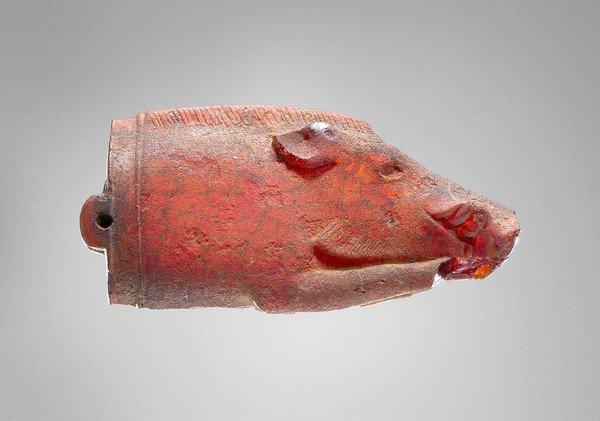 |
| A problematic Amber piggie? |
The review is likely to reveal that problems in the Getty's collection go far deeper than the nearly 50 looted objects returned since 2007 , according to Getty records and interviews with antiquity dealers and former museum officials. Hundreds of objects still in the collection were acquired with false ownership histories aimed at disguising their origins in the illicit antiquities trade, records and interviews show. The depth of its problem was underscored in November, when the Getty published a catalog of 56 carved ambers, objects that the ancient Greeks and Etruscans used in amulets for the magical properties they were believed to possess. At first look, "Ancient Carved Ambers in the J. Paul Getty Museum" represents the museum at its finest -- decades of scholarship published online in an illustrated catalog that engages the public in a rarely studied artifact of the ancient world. But records -- including internal Getty files -- show that the ambers were almost certainly looted from tombs in northern Italy.
 |
| This Pyramid at Dahshour is being threatened |
In the case of Dahshour, villagers say their cemeteries are full and authorities don't give permits or land for new ones. So they took matters into their own hands and grabbed what they insist is empty desert to erect family tombs. "The dearest thing for us is burying our dead," said Mohammed Abdel-Qader, a resident of nearby Manshiet Dahshour. "This land here is wide and flat, it's a valley. Where are the antiquities they talk about? ... We have no antiquities here.". . .The cemetery expansion is the most dangerous encroachment yet because of how close it comes to the Dahshour monuments, which are on the UNESCO World Heritage site list, Younes said. Moreover, Dahshour is largely unexcavated, since the area was a closed military zone until 1996. What remains buried is believed to be a treasure trove shedding light on the largely unknown early dynasties. "When you build something over archaeological site, you change everything. We can't dig in and know what is inside," Younes told The Associated Press. "This is the only virgin site in all of Egypt."
 |
| The head of Hades, likely looted from Morgantina, to return to Aidone in 2014 |
A look at the Amazigh and the ongoing conflict in Libya illustrates this issue. This article seeks to investigate the problems that are caused by a lack of governing laws and conventions by using the Amazigh as a lens into the issue, and to serve as a catalyst for further exploration of the subject. This article’s primary purpose is to draw attention to the debate about indigenous antiquities and cultural property, while acknowledging that events surrounding the debate are constantly developing. More specifically, this article asserts four main points. First, because indigenous communities are already underrepresented in their societies, a barrier is created that prevents the recognition of threats to their archaeological artifacts and cultural property. Second, there is often a dearth of information associated with antiquities of indigenous communities, making current bodies of law difficult to apply. Third, even if such information were available, current international law is still inapplicable because it is seriously inadequate when it comes to addressing indigenous artifacts and cultural property. And fourth, the complex nature of But very few of these conventions and treatises address indigenous antiquities and cultural property. This is especially true when an indigenous community has been oppressed by a governing regime that is later overthrown, and when specific information regarding the indigenous community’s antiquities is difficult to obtain or perhaps even nonexistent. Given the large number of indigenous communities in the world, this is an issue that must be addressed. A look at the Amazigh and the ongoing conflict in Libya illustrates this issue. This article seeks to investigate the problems that are caused by a lack of governing laws and conventions by using the Amazigh as a lens into the issue, and to serve as a catalyst for further exploration of the subject. This article’s primary purpose is to draw attention to the debate about indigenous antiquities and cultural property, while acknowledging that events surrounding the debate are constantly developing. More specifically, this article asserts four main points. First, because indigenous communities are already underrepresented in their societies, a barrier is created that prevents the recognition of threats to their archaeological artifacts and cultural property. Second, there is often a dearth of information associated with antiquities of indigenous communities, making current bodies of law difficult to apply...


