Sep 14, 2010

This Roman Helmet "Just" a Portable Antiquity

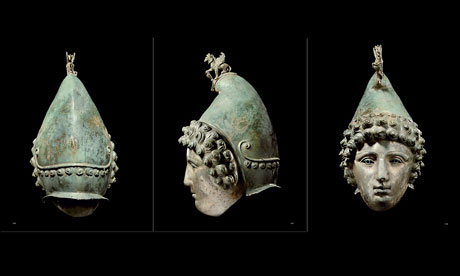
The Crosby Garrett Helmet, a Roman bronze cavalry parade helmet
The Crosby Garrett Roman Helmet
This stunning bronze helmet was unearthed in Crosby Garrett in Cumbria in the North of England, not too far from the Lake District.  It was discovered in 33 fragments, face down in the mud on a Roman road.

The helmet belongs to the finder and the landowner, as this helmet does not qualify under the Treasure Act.  It has been pieced together apparently by Christie's auction house which will sell the piece at an auction in October.  It might fetch as much as 300,000 GBP.  Though the piece does not qualify as treasure, it likely would be of "Waverley" quality and thus any export would be delayed to allow domestic organizations an opportunity to match any purchase price.  I've pointed out some of the benefits of the Portable Antiquities Scheme--the voluntary program which encourages the reporting of objects like this which fall below the treasure threshold. But this case presents a troubling result in many ways, as this object was cleaned for sale by Christie's.  We do not know anything about the deposits left on the helmet, or how the helmet was abandoned in pieces along an old Roman road.  Roger Bland also points out the unpalatable consequences of this find:  "It is a pity that the object was restored before there was any opportunity to examine it scientifically, as that would have given us more information about how it came to be in the ground . . .  We hope it will be possible for there to be an archaeological examination of the find spot."


  1. Maev Kennedy, “Roman cavalry helmet found with metal detector may go abroad at auction,” September 13, 2010, http://www.guardian.co.uk/culture/2010/sep/13/roman-helmet-metal-detector-cumbria.
  2. Roger Bland, “Exceptional Roman cavalry helmet discovered in Cumbria - News section,” n.d., http://www.finds.org.uk/news/stories/article/id/195.


View Larger Map

Sep 13, 2010

"nothing less than a theft of the art from Fisk"

 So says Fisk University in response to the Tennessee State Attorney Generals proposal for disposition of the Fisk-Stieglitz Collection.  In a proposal filed Friday in the Chancery Court Attorney General Robert Cooper would have the Tennessee Arts Commission take temporary possession of the collection.  Fisk University is seeking approval in Chancery Court for the approval of a partial sale of the collection to the Crystal Bridges Museum in Bentonville Arkansas for $30 million.  Lee Rosenbaum notes that the Tennessee AG's proposal would "honor donor Georgia O'Keeffe's expressed wishes and do justice to a celebrated collection that was under-utilized at Fisk (which, for a time, had placed the Stieglitz Collection in storage at the Frist). But the deal would leave Fisk without its coveted $30-million windfall from Crystal Bridges". 

This means the Chancery court will now have to weigh the sale of a partial interest in the collection in Arkansas in a move which might allow Fisk University to avoid closing for good against a plan which would keep the art in Nashville year-round but give very little compensation to the University. 

Donn Zaretzky, like Fisk University, is not a fan of the AG's proposed Nashville-first settlement:

This of course does nothing (or very little) for Fisk, but, as we all know, benefiting Fisk was not part of O'Keeffe's intent when she gave the Collection to Fisk. She could care less about Fisk! In fact she hated Fisk! What she really cared about was the People of Nashville. If Fisk goes under, hey, stuff happens. Not our problem. Our problem -- as Lovers of Art -- is to see to it that the donor's intent is always satisfied. And obviously in this case O'Keeffe would have preferred that the works be shown at the Frist Center than have Fisk share the Collection with the Crystal Bridges Museum. So this is a Good Day For Art: the works will be leaving Fisk, but instead of going to Museum A, they will be going to Museum B, which is much better. Obviously.

  1. Erik Schelzig, Proposal made for art donated by O'Keeffe » Knoxville News Sentinel, http://www.knoxnews.com/news/2010/sep/13/proposal-made-for-art-donated-by-okeeffe/ (last visited Sep 13, 2010).

Sep 9, 2010

More on the Return of Cultural Heritage to Iraq

Yesterday on "All Things Considered" Farah Stockman talks about the return of the statue of King Entemena and other objects. Stockman talks about the comments of the Iraqi Ambassador:

It was very moving to hear him talk about the statue and what it meant to him personally to have it come back and how it was this metaphor for Iraq, basically how, you know, how destruction is so much quicker than construction. He said it took four days for them to loot all these things, and it's taken seven years for us to get even a third of them back. And he said we'll be working on this for 20 years, and we may never get them all back.
As good a description as any about the harms which flow from theft and destruction of heritage.  Yet a complicating factor in Iraq is ensuring that returned objects are cared for.  Larry Rothfield says the loss of another shipment of repatriated objects is "one more piece of evidence, if that were required, that the State Department dropped the ball completely by focusing its efforts on restoring the museum rather than on helping the Iraqis get their cultural policy infrastructure set up properly".
  1. Looted Iraqi Relics Return Home : NPR, , http://www.npr.org/templates/story/story.php?storyId=129731037 (last visited Sep 9, 2010).
Audio after the jump.


Sep 7, 2010

Are Iraq's Antiquities in a Revolving Door?

A 4,400 year old statue of King Entemena looted and now returned
In a ceremony today 542 works of art and objects were returned from the United States to Iraq.  Among the items returned were:

[A] 4,400-year-old statue of King Entemena of Lagash looted from the National Museum . . . an even older pair of gold earrings from Nimrud stolen in the 1990’s and seized before being auctioned at Christie’s in New York last December; and 362 cuneiform clay tablets that had been smuggled out of Iraq before the invasion . . .  There was also a more recent relic: a chrome-plated AK-47 with a pearl grip and an engraving of Mr. Hussein, taken by an American solider as booty and displayed at Fort Lewis, in Washington.

Yet a senior Iraqi official admitted that 632 other pieces returned by U.S. forces have apparently gone missing.  They were supposed to have been shipped to the Iraqi Prime Minister's office via a flight authorized by Gen. Petraeus, Steven Lee Myers reports for the NYT that antiquities returned to Iraq are in a "revolving door". Iraq's ambassador to the United States Samir Sumaidaie told reporters "“We asked the US military to move it to Iraq. When the pieces arrived in Iraq, they were delivered to the office of the prime minister and now we are trying to find them”.  Perhaps the attention paid to these newly returned artifact will help to recover the previous shipment.  
  1. Steven Lee Myers, Iraq’s Looted Treasures in a Revolving Door, The New York Times, September 7, 2010, http://www.nytimes.com/2010/09/08/world/middleeast/08iraq.html?_r=1&hp (last visited Sep 7, 2010).
  2. The Associated Press: Hundreds of looted artifacts returned to Iraq, http://www.google.com/hostednews/ap/article/ALeqM5hwK_CSpBxsNuVUEaDuOwmSSCiqGwD9I344LG2 (last visited Sep 7, 2010).
  3. Jane Arraf, 542 antiquities looted in Iraq war return home. Where are the rest?, Christian Science Monitor, , http://www.csmonitor.com/World/Middle-East/2010/0907/542-antiquities-looted-in-Iraq-war-return-home.-Where-are-the-rest (last visited Sep 7, 2010).
Video from the NYT after the jump.


Sep 2, 2010

Craig Childs on Archaeology

Craig Childs talks to NPR about his new book "Finders Keepers":

Author Craig Childs' new book, Finders Keepers: A Tale of Archaeological Plunder and Obsession, reads almost like a thriller, chock-full of vendettas, suicides and large-scale criminal enterprises dedicated to the multimillion-dollar trade in antiquities.

Childs tells NPR's Audie Cornish that emotions run high in the world of antiquities. "There's such an attachment to what is the right and wrong thing to do with these objects," he says. "What is legal? What is illegal? It really rises to the surface to where I know some archaeologists who want pot hunters dead, and I know pot hunters who want archaeologists dead." His book follows several families of pot hunters who ran afoul of the government after digging up relics on public land.

And many objects now in museums may not be legal, Childs says. For example, the famous Euphronios krater, an ancient Greek vessel for mixing wine and water, stood in the Metropolitan Museum of Art for almost 40 years. "You'd go into the Met and there it was, in its own display case," Childs says. "Just beautiful paintings of warriors and gods all around it, one of the finest Greek vessels ever found, and it was sold with paperwork that said, you know, this thing is legal." But an extensive investigation proved that the krater had been looted from an Etruscan tomb in Italy, and in 2008 the Met returned it to the Italian government.

Audio after the jump


Aug 28, 2010

More on the Security Breakdown in Cairo

The stolen work, "Poppy Flowers"
 A week ago today the 1887 work Poppy Flowers, by Vincent van Gogh was stolen from a Cairo museum.  Hadeel Al-Shalchi has a very good piece reporting on the security (or lack of it) at the  Mahmoud Khalil museum in a piece for the AP which you can read on MSNBC. 

I'm quoted at the end of the piece, noting that the best way to protect works of art is not necessarily with an elaborate electronic security system.  Those alarms and sensors certainly play an important role, but for a nation like Egypt, an active, engaged security guard who isn't dozing off as these guards perhaps were, would seemingly have been a successful deterrent for the thieves.  They apparently walked in and cut the work from the frame during hours the museum was open.  And I want to make clear that when I was quoted in the piece saying "It's not an exciting job, but you need to take it seriously", I mean that security staff at museums are professionals, and should be given that status.  In Cairo, these guards were certainly not expected or required to maintain an adequate standard, and the theft and damage of this artwork is the unfortunate result.  But hopefully Egypt will learn from this crime, and enact some sound security procedures to ensure more works of art are not stolen in the future. 

When Ms. Al-Shalchi called me to discuss the theft, she told me she had learned that many of the guards may have been praying—this is still Ramadan—while the theft was taking place, that they may have been dozing off, and that the museum was not heavily visited on the day of the theft.  But perhaps most troubling of all were the breakdowns in technology at the museum.  As the piece states, there were no working alarms, only seven of the 43 cameras were in operating condition, and video from the cameras is recorded only when a guard "senses" an incident may be taking place.  As Ton Cremers, founder of the Museum Security Network says, this is not a good state of affairs for the protection of such valuable artworks: "The value of the van Gogh is $40 (million) to $50 million . . .  A complete security system of that museum would be $50,000, and to keep it running would cost $3,000 a year. ... Need I say more?"

Also of interest will be the arguments against repatriation of other classes of objects—such as the bust of Nefertiti—on the grounds that Egypt is not going to be able to adequately care for the object when it is returned.  yet Art theft occurs in every nation, and bad security is bad security whether the museum is in Egypt, Europe, or North America.  Thieves will exploit obvious gaps in security.  As Mark Durney, current moderator of the Museum Security Network, asked this week "Why are some national collections not as well protected as others? Who, in addition to the thief, is responsible for the theft?"  I think that is the right set of questions to ask, yet they need to be asked whenever a museum is unprepared for a theft, whether that museum is in Egypt, or France—where the security system at the Modern Museum may have not been in working order earlier this summer when five works were stolen. 
  1. Hadeel Al-Shalchi, Security problems abound in Egypt's museums, Associated Press, http://www.msnbc.msn.com/id/38884911/ns/technology_and_science-science/ (last visited Aug 28, 2010).
(cross-posted at http://art-crime.blogspot.com/)
    Aug 27, 2010

    Footnotes

    The Dixie Brewery, 1979

    Aug 26, 2010

    Using Google to Police Sites in Jordan (and elsewhere perhaps)

    An Image of the MEGA database in action
    Randy Kennedy has a fascinating piece in the NY Times detailing the Middle Eastern Geodatabase for Antiquities (MEGA), which uses google earth satellite images to catalog and crowdsource sites and the conditions which may be threatening them.  the Getty Conservation Institute with financial support from the World Monuments Fund has been building the system over the last for years.  Kennedy reports the project will "allow archaeologists and conservators there, for the first time, to gain access to decades’ worth of records about Jordan’s sites and to monitor the condition of those sites much more easily". 

    Lest the website be used by looters to find sites, the information is currently restricted to a select group of individuals.  This project was originally designed to be implemented in Iraq, however "the chaos and violence in Iraq ultimately prevented the Getty from being able to work with officials there to create what was originally planned to be a local database program, not one that utilized the Web."  There are plans to implement the system in Iraq soon, and if this program works well in Jordan, and the middle east, this program could be implemented just about anywhere else in the world. 
    1. Randy Kennedy, Getty Institute Project in Jordan Helps Track Antiquities, The New York Times, August 24, 2010, http://www.nytimes.com/2010/08/25/arts/design/25getty.html?_r=1&emc=eta1 (last visited Aug 26, 2010).

    Aug 25, 2010

    Fanizzo on Property Management and the Antiquities Act

    Via the Land Use Prof Blog I see that Kelly Y. Fanizzo (Temple) has posted Politics, Persuasion, and Enforcement: Property Management Under the Antiquities Act.  Here is her abstract:

    Recognizing the tremendous loss to the nation that results from unchecked collecting and vandalism, Congress passed the Antiquities Act in 1906 to preserve threatened historic and scientific structures, ruins, and objects and protect against the loss of valuable scientific data. Granting considerable authority to the President, the Antiquities Act provides for the designation of national monuments through the withdrawal of public land. Over the past decades, numerous monument designations have raised questions about the limits of the President’s role in federal land management. But practical questions looming just beyond the President’s ability to designate a national monument only recently surfaced in a challenge to the Bureau of Land Management’s (BLM) grazing policies in the Sonoran Desert National Monument. This case before the Arizona District Court focused on the BLM’s management of the national monument, and not the process of its designation. This challenge sparked a discussion on how the protective intent of a monument proclamation can be best achieved. It asked what is the President’s authority to manage a national monument and when can a third party sue to force an executive agency to comply with the monument proclamation’s terms. This paper argues that consistent judicial review of an agency’s management of a monument can help national monument designations maintain their protective purpose. In the context of the Antiquities Act and more broadly, using this challenge as a case study allows us to consider what teeth are left in this law, now on the books for over a hundred years, to protect significant historic and scientific resources.


    Fifth Circuit Rules for Current Owner in Nazi-era Claim

    The 5th Circuit has held that Claudia Seger-Thomschitz is not entitled to regain the work Portrait of Youth by Oskar Kokoschka.  Sarah Blodgett Dunbar v. Claudia Seger-Thomschitz, No. 09-30717 (5th Cir. 2010).  The claimant, Seger-Thomschitz argued the work was confiscated in a forced sale from the Reichel family in 1939.  Sarah Blodgett Dunbar, a current resident of New Orleans, inherited the work in 1973 from her mother, who had purchased it in 1946 from a man named "Kallir" whom Seger-Thomschitz argued was a Nazi collaborator. 

    The suit was instigated by Dunbar after she received a letter from Seger-Thomschitz seeking the return of the work of art.  Dunbar defended the action under Louisiana's limitations rules, arguing the claims were barred by prescription.  Louisiana Civil Code article 3491 gives title to a current possessor to "one who has possessed a movable as owner for ten years acquires ownership by prescription."  Seger-Thomschitz argued that "Louisiana law should not be applied at all" and that the Terezin Declaration, a non-binding document promulgated at the Prague Holocaust Assets Conference in 2009 preempts state law.  The court was not convinced:

    Appellant has not met the burden of establishing extraordinary circumstances to justify consideration of a new legal theory for the first time . . .  Appellant offered no compelling reason why she failed to present this theory to the district court nor does it appear that a miscarriage of justice will result from our failure to address it. We are unpersuaded that this novel theory should be explored for the first time on appeal.

    Ms.  Seger-Thomschitz was also unsuccessful in her bid to seek the return of another Kokoschka work from the MFA Boston in June of last year. 

    Labels

    "Bronze Statue of a Victorious Youth" (17) 1954 Hague Convention (12) 1972 World Heritage Convention (1) Aboriginal Heritage (1) Aboriginal Heritage Act 1988 (SA) (2) act of state doctrine (1) Admiralty Law (11) Afghanistan (10) Africa (4) Albright-Knox Gallery (3) Aleppo (2) Alfred Stieglitz (2) Alternative Dispute Resolution (1) Angkor (1) Anti-Seizure Legislation (1) antiquites (3) antiquities (337) Antiquities Act 1906 (2) Antiquities leasing (10) antiquities looting (4) antiquities smuggling (3) antiquities theft (6) ARCA (8) ARCA Annual Conference (10) ARCA MA Program (6) Archaeological Resources Protection Act (5) Archival Recovery Team (ART) (3) Archives (1) Armed Conflict (22) Arrests (79) Art and Cultural Heritage Law (1) Art Beat Constables (9) Art Crime Statistics (1) art fraud (9) art history (1) Art Institute Chicago (3) art law (1) Art Loans (9) Art Loss Register (19) Art Market (10) Art Theft (263) Artist Resale Right (1) arts funding (1) Association of Art Museum Directors (AAMD) (8) Athens (3) Auction (99) austerity (2) Australia (7) Austria (3) Authentication (3) Babylon (3) Banksy (1) Big Bend National Park (1) bilateral agreements (2) Black Hills (1) Bolton Forgers (4) Book Theft (3) Brazil (5) British Museum (13) Bronze (5) Bronze Statue of a Victorious Youth (1) Brueghel (1) Bruno Lohse (3) Brussels (1) Bührle Collection Theft (4) Bulgaria (4) Burke and Wills (2) Burns Mummies (1) Byzantine Artifacts (4) Cairo (1) Cairo art theft (2) California Raids (6) Caligula (1) Cambodia (11) Camille Pissarro (7) Carabinieri (6) Caravaggio (1) catalogue raisonné (1) Cellini Salt Cellar (2) Central Park (1) Cerveteri (1) Chance Finds (3) Charles Goldie (1) Chihuly Glass (1) China (16) Christie's (14) Church Thefts (6) Civil War (2) Claude Monet (4) Claudia Seger-Thomschitz (3) Cleveland Bronze Apollo (2) Cleveland Museum of Art (CMA) (5) Coins (7) Colonial Art (1) Columbia (1) Conferences (7) Conservation (1) Conventions (1) Copyright (5) Corot (1) Corrections (1) cosmpoplitanism (4) Costa Rica (2) CPIA (10) criminal charges (5) criminology (1) Crystal Bridges Museum (5) Cultral Property Advisory Committee (9) Cultural First Aid (2) cultural heritage (6) cultural heritage careers (2) Cultural Heritage Moot Court Competition (2) Cultural heritage movement (1) cultural justice (3) cultural policy (18) cultural property (4) Cultural Resource Management (1) cultural security (1) culture funding (1) curatorial theft (2) Cycladic Figurines (1) Cyprus (9) Dahshour (1) Dallas Museum of Art (DMA) (2) Database (5) Databases (4) DCMS (2) Deaccessioning (24) Dead Sea Scrolls (1) Dealing in Cultural Objects (Offences) Act 2003 (4) Declaratory Suits (4) Demand and Refusal (2) Design and Artists Copyright Society (1) Detroit Institute of Art (1) development (1) Dick Ellis (2) Diplomatic Bags (1) Doctrine of Discovery (3) Donald Trump (3) Donny George Youkhanna (2) Dr. No (6) Droite de Suite (2) Dubai (1) due diligence (5) eBay (5) Economics (1) Ecuador (1) Edgar Degas (2) Edinburgh (1) Edoardo Almagia (1) Edvard Munch (2) Egon Schiele (4) Egypt (55) El-Hibeh (2) Elgin Marbles (5) empirical studies (1) England (4) environmental justice (4) Environmental law (2) Erik Nemeth (1) Etruscans (2) Euphronios Krater (4) European Court of Human Rights (1) Export Restrictions (19) Fakes (6) FBI (16) FBI Art Crime Team (16) Festivus (1) Fifth Circuit (1) fire (1) Fisk University (3) Footnotes (59) force multiplier (1) Foreign Sovereign Immunities Act (FSIA) (6) forfeiture (13) Forgery (27) fossils (2) Four Corners Antiquities Investigation (11) fractional ownership (2) Francavilla Marittima (1) France (30) Francesco Rutelli (15) Frans van Mieris (2) Frederick Schultz (3) freedman's town (2) Gaza (1) George Grosz (1) Georgia (1) Georgia O'Keeffe (2) Germanicus (2) Germany (16) Getty (1) Ghent Altarpiece (1) Giacomo Medici (6) Gianfranco Becchina (1) Golf (3) good faith (3) Goya (3) Goya theft (4) graffiti (1) Greece (38) Grosz (1) Henri Matisse (1) Henry Moore (1) Heritage at Risk (1) heritage crime (1) Heritage Crime in Art (1) Hermitage (2) High Court in London (4) historic documents (1) Historic Landmark (1) historic preservation (1) historic weapons (1) Holocaust (Return of Cultural Objects) Act (2) Hopi (1) House of Commons Illicit Trade Advisory Panel (ITAP) (1) Houston (2) Howard Spiegler (2) Human Remains (5) Human Rights (1) Hungary (1) Identification (1) illicit excavation (1) Immigration and Customs Enforcement (16) Immunity (6) Immunity from Seizure Act (ISA) (3) import restrictions (3) in the media (7) Indemnity (1) Indianapolis Museum of Art (5) indictments (5) Indigenous Rights (2) Indonesia (1) injunctions (1) Insider Theft (2) Institute d'Egypte (1) Institute of Art and Law (1) Institutional theft (1) Intellectual Property (4) Intentional Destruction (6) International Criminal Court (ICC) (1) International Journal of Cultural Property (1) internationalism (4) INTERPOL (1) Interview (2) Interviews (2) Iran (8) Iran v. Barakat Galleries Ltd. (6) Iran v. Berend (3) Iraq (46) Isabella Stuart Gardner Museum (7) Islamic art (2) Israel (4) Istanbul (2) Italian Art Squad (5) Italian Culture Ministry (6) Italy (122) Jacques Goudstikker (4) James Ossuary (1) Jan Breugel the elder (2) Jan van Eyck (1) Japan (3) Jeanneret v. Vichy (1) Jeff Tweedy (1) Jenack v. Rabizadeh (1) JMW Turner (2) John Constable (1) Jonah Marbles (1) Jonathan Tokeley-Parry (1) Jordan (2) Joseph Farquharson (2) Journal Articles (1) Journal of Art Crime (1) Ka-Nefer-Nefer (9) Kansas (2) Kansas City (1) Kazimir Malevich (3) Kenya (1) Kingsland (3) Klimt (3) Koh Ker (6) Konowaloff v. Metropolitan Museum of Art (1) Kunsthal Museum Theft (2) La Dea Di Morgantina (6) Lawrence Kaye (1) Lebanon (1) Leonardo Da Vinci (9) Leopold Museum (1) Lewis Chessmen (5) lex originis (3) lex situs (5) Libya (2) Lincoln's Inn theft (1) Lithographs (1) loans (5) London (6) London Art and Antiques Unit (7) London Metropolitan Police (2) loot (1) looting (30) Los Angeles County Museum of Art (LACMA) (2) Los Angeles Museum of Contemporary Art (MOCA) (1) LS Lowry (3) Lucas Cranach (1) Lucas Cranach the Elder (3) Lucian Freud (1) Macedonia (1) Machu Picchu (12) Madonna of the Yarnwinder (recovery) (9) Mali (4) Malta (1) Manchester (2) manuscript (1) Maori (2) maps (2) Marc Chagall (1) Marion True (25) Mark Landis (1) market overt (1) Mausoleum at Helicarnassus (1) Max Stern (3) Maxwell Anderson (3) metal detecting (6) Metropolitan Museum of Art (the Met) (29) Mexico (9) Meyer de Haan (1) MFA Boston (6) Michael Brand (3) Michael C. Carlos Museum (1) Michael Steinhardt (2) Middle Eastern Geodatabase for Antiquities (MEGA) (1) Minneapolis Institue of Arts (MIA) (1) Moctezuma's Headdress (1) Modigliani (2) MoMA (4) Mondrian (1) Monet (3) Montreal Museum of Fine Art (2) Monument Men (5) Monuments Men (1) Moral Rights (3) Morgantina (2) Morgantina Aphrodite (9) Morgantina Treasure (1) Moscow (2) Musée d'Art Moderne theft (1) Museum Acquisitions (1) Museum Governance (1) Museum of Anatolian Civilizations (1) Museum of Fine Arts in Boston (6) museum security (2) museum theft (2) Museums Libraries and Archives Council (MLA) (1) Music (2) Myth (1) Napoleon III (1) National Academy (2) National Archaeological Museum in Naples (1) National Archives (3) National Gallery (Washington) (1) National Historic Preservation Act (2) National Stolen Property Act (8) nations of origin (5) Native American Graves Protection and Repatriation Act (8) Native Americans (17) native cultures (2) Nazi Spoliation (74) Neglect (1) Neil Brodie (1) Nelson-Atkins' Bloch Building (1) Netherlands (10) New Acropolis Museum (3) New Orleans (4) New York (6) New Zealand (7) Nigeria (1) nighthawking (3) Noah Charney (1) Norbert Schimmel (1) Norman Palmer (1) Norman Rockwell (2) Norway (4) NSPA (1) Nuclear Analytical Techniques (1) Odyssey Marine Exploration (23) Olympics (2) Omaha Nebraska (1) Organized Crime (1) Orphaned Works (2) Oskar Kokoschka (2) Oslo (1) Pablo Picasso (16) Pakistan (2) Palestine (3) Panama (1) Paolo Ferri (2) Paris (10) partage (1) Parthenon Marbles (17) Patents (1) Patty Gerstenblith (1) Paul Bator (2) Paul Cezanne (5) Paul Gauguin (4) Pazardzhik Byzantine Silver Hoard (1) Penn Museum (1) Pentagon (1) Pere Lachaise (1) Persepolis (3) Peru (24) Peru Headdress (1) Peter Watson (1) Philadelphia (7) Phillipines (1) Picasso (9) Pierre Le Guennec (1) Pierre Valentin (1) piracy (1) Pollock (1) Pompeii (3) Popular Culture (1) Portable Antiquities Scheme (25) Portrait of Wally (11) Poussin (1) pre-Columbian antiquities (2) pre-emptive archaeology (1) Prince Claus Fund (1) Princeton (4) Private Collectors (2) Private International Law (5) Proceeds of Crime Act 2002 (UK) (1) Prosecutions (7) provenance (13) Prussia (1) Public Art Theft (5) Public Trust (1) Publications (2) Quran (1) Radio (2) Ransom (2) realkulturpolitik (1) recovery (45) Rembrandt (2) Rene Magritte (2) Renoir (2) Renvoi (3) repatriation (121) Restitution (40) reward (1) Rhodes (1) Robert Hecht (8) Robin Symes (1) Rodin (2) Roger Atwood (1) Roman Objects (2) Rome (3) Rothko (1) Royal Academy (1) Rubens (3) Rubin v. Islamic Republic of Iran (2) Russia (11) Sale of "The Cello Player" (1) Sale of the "Gross Clinic" (11) Sale of the Stieglitz Collection (4) Salvage (1) Sao Paulo (2) Sao Paulo Museum of Art (3) Scheduled Ancient Monuments (1) Scholarship - Articles and Essays (57) Scholarship - Book Reviews (3) Scholarship - Books (12) Scholarship - Case Notes (1) Scholarship - Events and Conferences (55) Scholarship - Journal Articles (12) Scholarship - Student Papers (16) Scotland (7) Scotland Yard's Arts and Antiques Squad (1) scrap metal (1) Sculpture (2) security (4) seizure (16) Selling stolen art (1) seminars (1) semiotics (1) Sentencing (2) Serbia (1) settlement (1) Sevso Treasure (6) Shelby White (3) shipwreck (1) Sicily (4) Simon Mackenzie (2) Sisley (4) Slovakia (1) Smithsonian (4) Solomon R. Guggenheim (1) Sonic Fingerprints (1) Sotheby's (13) Sotheby's Paris (1) South Africa (1) South America (1) Spain (21) Spoliation (2) Spoliation Advisory Panel (8) St. Louis Art Museum (8) St. Ninian's Isle Treasure (3) Stair Gallery (2) State Department (2) Statue of a Victorious Youth (1) statute of frauds (1) Statutes of Limitations (10) Stephane Breitwieser (1) Stephen Colbert (1) Steven Spielberg (1) stewardship (2) Stolen Art (11) Stone Age (1) street art (1) study collections (1) Summer Palace Bronzes (7) Sweden (2) Switzerland (13) Syria (7) Taliban (1) Tennessee (3) The Art Fund (1) The Bowers Museum (1) The Discovery Rule (4) the fourth ward (1) The Getty (58) The Gross Clinic (1) The Guggenheim (2) The Holocauset (stolen art) restitution bill (2) the Louvre (2) The Menil (4) The National Gallery (1) The National Gallery (London) (2) the Pirate Party (1) The Scream (1) theft (2) Thomas Eakins (9) Thomas Jefferson (1) Timbuktu (2) Titian (1) Toledo Museum of Art (4) tombaroli (2) tourism (1) transparency (1) Traprain Law (1) Traveling Exhibitions (2) Treasure Act (4) treasure trove (3) Turkey (11) UCC (1) Ukraine (2) UN (2) Underground Salt Museum (1) Underwater Cultural Heritage (32) Underwater Sites - "Black Swan" (3) Underwater Sites - "Blue Baron" (1) Underwater Sites - HMS Victory (3) UNESCO (23) UNESCO Convention (24) UNESCO Convention on the Protection of Underwater Cultural Heritage (9) UNIDROIT Convention (2) United Kingdom (24) United States (12) University College London (1) University of Chicago (1) University of Guelph (1) University of Virginia (3) urban development (1) Van Gogh (7) Vandalism (4) Vatican (1) Vermeer (2) Victoria And Albert Museum (3) Vigango (3) viking (1) Villa Giulia (3) Vineberg v. Bissonnette (4) Visual Artists Rights Act (2) voluntary returns (1) Von Saher v. Norton Simon Museum of Art at Pasadena (3) Watts Towers (1) Waverley Criteria (10) Week in Review (3) West Bank (1) wikiloot (1) Wilco (1) William S. Burroughs (1) Windsor Antiquities Indictment (1) World Heritage Sites (1) World War II (11) Yale University (13) year in review (2) Zahi Hawass (9)

    LinkWithin

    Related Posts Plugin for WordPress, Blogger...