ABSTRACT: Since World War II, the debate between cultural internationalists and cultural nationalists has shaped international cultural-property law. Recently, some American museums, engaged in their enduring struggle to balance a mission of public education and scholarly study with the increasing risk of acquiring artifacts of disputed provenance, began to promote a middle ground of “cooperation, mutual understanding, and respect” between acquiring museums and source countries that builds upon the goals of the UNESCO Convention on the Means of Prohibiting and Preventing the Illicit Import, Export and Transfer of Ownership of Cultural Property. This new approach, defined here as “cultural pragmatism” attempts to bridge the impasse between advocates of the two opposing doctrines that has resulted from the adversarial climate following the Second Circuit’s decision in United States v. Schultz and the new power of foreign patrimony laws to reach antiquities imported into the United States. This Note analyzes the new approach and offers the classification system of the Japanese Law for the Protection of Cultural Properties as a means to its further implementation.
Apr 7, 2010
Student Note on "Cultural Pragmatism"
Matthew Hoffman, J.D. candidate at the University of Iowa has an article, Cultural Pragmatism: A New Approach to the International Movement of Antiquities, 95 Iowa L. Rev 667 (2010). Here is his abstract:


Apr 6, 2010
Unsuccessful Restitution Suit by German Museum
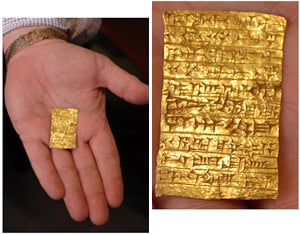 | |
| An Ancient gold tablet, excavated from Northern Iraq in 1913. |
A German Museum has lost an action against Riven Flamenbaum to recover this ancient gold tablet that may be worth as much as $10 million. You can read the opinion here, in Matter of Flamenbaum, File No. 328416.
The tablet has quite a history. It was unearthed in 1913 in Ashur, present day Qual'at Serouat by German archaeologists. It was bound for a German museum, but World War I forced the ship carrying it to Portugal, where the object was stored until 1926. In 1934 the tablet was put on display in the Vorderasiatisches Museum. At the end of the war, in 1945 it was discovered the tablet was missing, perhaps looted by Soviet troops. It is at this point that Flamenbaum—a survivor of Auschwitz—encountered the tablet, which he may have purchased on the streets of post-war Berlin for some cigarettes. He took the tablet with him when he emigrated to New York in 1949. He had no inkling of the object's value, after it had been apparently appraised for as little as $100 at one point. The family contacted the Museum in 2006 after Flamenbaum's death, and the museum brought suit to recover the tablet.
In New York, this action was within the statute of limitations because the period does not begin to run until an original owner demands an object and is refused—which in this case was 2006. However Surrogate John Riordan held that the museum had waited too long to bring this claim under the doctrine of laches—an equitable doctrine which essentially posits that it wouldn't be fair to allow the claimant to regain title. The court held the lack of any real effort by the museum to seek the return of the tablet was unreasonable. Surrogate Riordan placed a good deal of weight on an apparent 1954 report of the object's location. But the opinion does not offer any details of this report.
The Museum had not really had possession of the tablet for very long, and had not made extensive efforts to contact post-war authorities or stolen art registries. But of course it is not necessarily clear if those efforts would have even been successful. Moreover, in some cases publicizing a theft in this way seems to run counter to the policy which underpins New York's Demand and Refusal rule. If you publicize the theft, that recovery may make diligence less likely, and might encourage other possessors of objects with questionable histories to move objects to other jurisdictions.
One wonder perhaps how much the underlying equities were a factor in the decision as well, with a seemingly-innocent Holocaust survivor acquiring the small tablet, without knowing its true value.
- Vesselin Mitev, German Museum Loses Attempt to Reclaim Artifact From Estate, New York Law Journal, April 6, 2010.
Apr 1, 2010
Footnotes

- Mardi Gras Indians in New Orleans file copyright suits against photographers who take their photographs without compensating them.
- Deaccessioning running rampant in today's art world.
- The Department Interior's decision to return human remains to Indian tribes and Native Hawaiians that are currently in museums and natural history collections will take effect May 14, 2010.
- A couple of New York art dealers have recovered stolen art, but these recoveries are only minor successes in the $6 billion a year art theft industry; the art was found in Canada.
- The two authors of Property Outlaws have written a detailed article about the law of fair use and "permission-based" creation of art.
- Federal appeals court justices debated whether a U.S. man should sue in Spain and Germany before suing in the U.S. to recover a Pissarro painting stolen by the Nazis.
- Hundreds of artworks from a state-run museum in Ankara, Turkey have perhaps been replaced by fakes or even gone missing.
Mar 30, 2010
Two Guilty Pleas in Four-Corners Antiquities Investigation
On Monday two pleaded guilty to stealing government property and violating the Archaeological Resources Protection Act. Both Brent Bullock and Tammy Shumway had been among those indicted during a federal investigation into looting Native American sites in the Four Corners region in the Southwest. From the AP:
A couple points which might not be evident from some of the coverage of these plea deals. First, sentencing will occur in July; and the AP piece notes the maximum sentence is 12 years in prison. Neither of these defendants will likely receive anything close to the statutory maximum. That is because when a defendant enters into a plea deal, they do so in most cases to achieve a recommendation from prosecutors on sentencing; which will often fall far below the maximum sentences. This should not be construed as authorities in the United States not taking these crimes seriously—rather a reflection of the general criminal procedures when plea agreements are reached.
Second, Tammy Shumway is the widow of Earl Shumway, a notorious antiquities looter. Shumway became a national figure in the 1980's, who boasted that he began looting at three years old with his father. He sold a large collection of over thirty prehistoric baskets and sold them for a great deal. Though he was prosecuted for selling those baskets, he cooperated with authorities and only received probation. He went right back to looting, using a helicopter and even lookouts to avoid authorities. He boasted to the media that he could never be apprehended. Though he was not caught in the act of looting, authorities did secure a conviction using DNA evidence found on Mountain Dew soda cans he left in the areas he looted. In 1995 he received a 5-year prison sentence which sent a message that Federal agents and prosecutors took this kind of crime seriously.
Bullock, 61, sold several ancient Indian items to an undercover operative in 2007, including a blanket fragment for $2,000 and a hoe-like tool for $500, according to court documents. He also offered to sell several ceramic figurines taken from U.S. Bureau of Land Management land.
Bullock said he wanted to sell the items because he was in debt, according to a search warrant affidavit.
Investigators said Bullock acknowledged to the informant that the items came from public land in Utah but filled out paperwork saying they were from private land in Colorado.
Shumway, who introduced Bullock to the informant, was charged because the 40-year-old woman aided and abetted the deals and signed a falsified paper about the items' origin as a witness, federal officials said.
In U.S. District Court on Monday, Bullock and Shumway acknowledged they knew the items had been illegally dug up from public land in Utah. As part of a plea deal, they each pleaded guilty to one count of trafficking in stolen artifacts and theft of government property. Prosecutors agreed to seek a reduced sentence.
A couple points which might not be evident from some of the coverage of these plea deals. First, sentencing will occur in July; and the AP piece notes the maximum sentence is 12 years in prison. Neither of these defendants will likely receive anything close to the statutory maximum. That is because when a defendant enters into a plea deal, they do so in most cases to achieve a recommendation from prosecutors on sentencing; which will often fall far below the maximum sentences. This should not be construed as authorities in the United States not taking these crimes seriously—rather a reflection of the general criminal procedures when plea agreements are reached.
Second, Tammy Shumway is the widow of Earl Shumway, a notorious antiquities looter. Shumway became a national figure in the 1980's, who boasted that he began looting at three years old with his father. He sold a large collection of over thirty prehistoric baskets and sold them for a great deal. Though he was prosecuted for selling those baskets, he cooperated with authorities and only received probation. He went right back to looting, using a helicopter and even lookouts to avoid authorities. He boasted to the media that he could never be apprehended. Though he was not caught in the act of looting, authorities did secure a conviction using DNA evidence found on Mountain Dew soda cans he left in the areas he looted. In 1995 he received a 5-year prison sentence which sent a message that Federal agents and prosecutors took this kind of crime seriously.
- Timothy Egan, In the Indian Southwest, Heritage Takes a Hit, N.Y. Times, November 2, 1995.
- Mike Stark, 2 Utahns plead guilty in sweeping artifacts case, AP, March 29, 2010.
Mar 29, 2010
New 6-week Course on First Aid to Cultural Heritage
I've been forwarded information on a new course sponsored by the International Centre for the Study of the Preservation and Restoration of Cultural Property (ICCROM) on First Aid to Cultural Heritage in Times of Conflict in collaboration with UNESCO and the Blue Shield network.
Here are the details:
Here are the details:
Dates: 17 September - 29 October 2010 (6 weeks)
Place: Rome, with study visits to other cities in Italy
With the cooperation of: UNESCO, Blue Shield and specialized international and national agencies
BackgroundIn the past decades, armed conflicts worldwide have involved deliberate or accidental damage to cultural heritage. Conflicts cause the weakening of governments and societies and endanger the core values that hold communities together. Cultural heritage thus plays a crucial role in recovering from such situations. In times of conflict, however, all operations can be delayed because access is often restricted by military, security, or law enforcement agencies. Consequently, it is essential for everyone working in these areas to understand how and when to intervene to protect endangered cultural heritage while humanitarian efforts are under way.
Objectives
- Understand the values associated with cultural heritage and the impact that conflict has on them;
- Apply ethics and principles of conservation in extreme conditions;
- Assess and manage risks to cultural heritage in conflict situations;
- Take peacetime preparatory action to improve response in times of conflict;
- Secure, salvage and stabilize a variety of cultural materials;
- Understand international legal instruments protecting cultural heritage during conflicts;
- Communicate successfully with the various actors involved, and work in teams;
MethodologyThe course will comprise of interactive lectures, group activities, practical sessions, simulations, site visits and case studies. Participants will be asked to develop case studies drawing from their own experience and work context.
ParticipantsThe course is aimed at those who are actively involved in the protection of cultural heritage within a variety of institutions (libraries, museums, archives, sites, departments of antiquities or archaeology, religious and community centres, etc.). It is also aimed at professionals from humanitarian and cultural aid organizations, as well as military, civilian and civil defense personnel. Those with experience in conflict situations are particularly encouraged to apply.
A maximum of 22 participants will be selected.
Working Language: English
Course Fee: 900 € (Euro)
Travel, Accommodation and Living ExpensesParticipants are responsible for their round-trip travel costs to and from Rome, Italy, and for all living expenses. To cover the cost of living, participants should plan for a minimum allowance of 2,000 € (Euro) for the entire duration of the course. This sum is based on the cost of moderately priced accommodations. Candidates are strongly encouraged to seek financial support from sources such as governmental institutions, employers and funding agencies.
Financial AssistanceUpon request, the organizers will offer financial support to a limited number of selected candidates who can demonstrate their inability to secure funding.
ApplicationPlease use the ICCROM application form [http://www.iccrom.org/eng/01train_en/forms_en/applfrm_ en.doc]. In your submission, include a 700-word personal statement that summarizes your experience and highlights the relevance of the course to your current or future projects. Applications should be sent by regular mail to the following address or by e-mail:
First Aid to Cultural Heritage in Times of ConflictCollections Unit - ICCROMVia di San Michele,1300153 ROME RM, ITALYTel +39 06 585531 Fax +39 06 58553349
E-mail: aidinconflict@iccrom.org
Application deadline: 14 May, 2010
This initiative received the financial support of the Italian Ministry of Culture (MiBAC)
Mar 26, 2010
Footnotes 3.26.2010

- King Tut is taking a tour through New York, first stopping at the Met (for the 30 year anniversary), then the Brooklyn Museum, and lastly Times Square.
- An interesting new art and literary magazine, title Sw!pe, speaks from the viewpoint of museum security staff.
- Some feel that museums have a moral obligation to return Nazi-looted .
- The Staffordshire Hoard will remain in the north of England.
- Mark Durney will take over as new management of the Museum Security Network, though it appears Ton Cremers will continue to forward on information to the network.
- Colonel Matthew Bogdanos, author of Thieves of Baghdad, will be speaking at Georgetown University Law Center on April 13th at 7:00pm.
Mar 25, 2010
On Looting in Lebanon

But it also has a rich material heritage. An anonymous looter tells Rana Moussaoui that:
"I know that these are historical artifacts, but much of the time I don't know their exact value," Abu Nayef admitted to AFP in his garden in Baalbeck.
"Sometimes we even move from one piece of land to another through tunnels, if we think we can find new vestiges," he added. . . .
"I have a wife and six children to support, and I do so through this business," he explained.
This problem plagues a number of nations, but Lebanon has had particular difficulty. Looting became widespread during the civil war between 1975-1990. Funding for heritage preservation and policing is lacking, and there are a number of important sites. In what is an otherwise sound article, Moussaoui criticizes the National Museum in Beirut for "showcasing 2,000 archaeological relics" while "hundreds of thousands of other pieces are gathering dust in storage". That ratio could probably be found in just about any museum; what goes on display is only the tip of the iceberg. It may not be fair to criticize Lebanon for what is a common situation all over the World.
Rana Moussaoui, Lebanon's archaeological sites a pillager's paradise, AFP Mar.25, 2010.
Mar 23, 2010
Interview with Cuno and Gerstenblith on Minnesota Public Radio
James Cuno, prominent critic of what he calls cultural nationalism, shares an extended interview with Prof. Patty Gerstenblith on Minnesota Public Radio. Kimberley Alderman notes the "arguments themselves are not particularly unique to these discussions, but its kind of fun to hear the host and Gerstenblith sock it to Cuno on a couple of points (especially when he’s being smug)." Is Cuno really smug? Feel free to give the interview a listen and offer your thoughts in the comments below.
Here's the MPR audio.
Larry Rothfield also notes the moderator "calls Cuno's bluff", and also notes the City University New York will be hosting a discussion on April 7th with Rothfield, Cuno, and Lawrence Coben in which focus will be placed on practical responses to the current looting of antiquities.
Here's the MPR audio.
Larry Rothfield also notes the moderator "calls Cuno's bluff", and also notes the City University New York will be hosting a discussion on April 7th with Rothfield, Cuno, and Lawrence Coben in which focus will be placed on practical responses to the current looting of antiquities.
Mar 17, 2010
Gardner Heist 20th Anniversary

The FBI and U.S. Attorney's office are re-publicizing their offer of unconditional immunity to anyone who helps locate any of the 13 stolen works of art from the Gardner heist. Anyone with information regarding the Gardner Museum theft should contact the Boston FBI office at 1-617-742-5533.
There have been a slew of details on the theft in recent days, here are a few:
- Charles Hill, a former Scotland Yard detective, says art thieves are not that smart and do not deserve the glamour they receive from heists.
- One of the least interesting items stolen in the infamous Gardner heist could turn over valuable clues.
Mar 16, 2010
Footnotes 3.16.2010

- 3,000 year-old wooden sarcophagus is returned to Egypt after being confiscated at the Miami Airport.
- A Philadelphia museum sues over $1.5 million art swindle.
- Suit filed over fake Native American art.
- Efforts to battle sophisticated art-theft rings are halted by public misconception regarding the importance of art theft.
- Unnoticed Chinese vase goes for 70 times it's asking price at a public auction in Ireland.
- Sotheby's will sell at auction a Nazi-looted Jean Baptiste Camille Corot painting.
- Egypt and Ecuador agree to return looted antiquities to their country of origin.
- Three Russian brothers dominate the legal forgery market.
Subscribe to:
Posts (Atom)
LinkWithin
