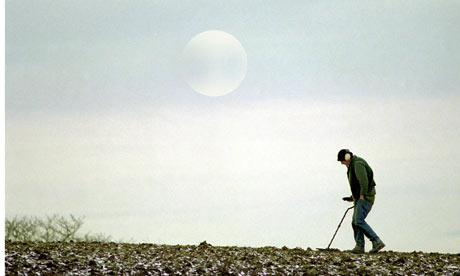
For my thoughts on the PAS, see here. For a published examination of how we might apply the PAS and some of its policies elsewhere, see here.As the money that funded an unprecedented explosion of professional archaeology during the economic boom years runs out, public hunger to peel back the past beneath our feet is helping to fill the gap. So the grots are identifying lost villages and settlements, Roman forts and temples, previously unknown trade routes; even mapping the slow ebb of the Roman empire from Britain.
By law, you must have a licence to excavate or remove even a pebble from a scheduled ancient monument or listed building, and all treasure finds anywhere must be reported. But anyone can pick up a metal detector – there are an estimated 180,000 in Britain – and take it into a ploughed field with the permission of the landowner. Fired by an unprecedented public interest in archaeology, thousands of people are doing just that, and the finds they report, often almost worthless in terms of cash, are proving true treasure.
"This is revolutionary stuff," says Sam Moorhead, a coins expert at the British Museum, who is in charge of the coins reported under the Portable Antiquities Scheme (PAS). "Gold doesn't map settlements – high-status coins could be hidden or lost anywhere. But where you've got 100 grots, you've got a settlement."
The grots have only been reported since 1996, when the PAS began establishing a national network of finds officers, to record and crucially map all the archaeological objects found by amateurs. The scheme has gradually forged a truce between most career archaeologists and the metal detectorists many previously regarded as little better than looters.
Reports of finds from bronze-age arrows to second world war cap badges are now running at 50,000 a year. Gradually, the detectorists realised that the archaeologists were interested in the rubbish in their grot pots. This week the scheme recorded its 400,000th object, a classic grot from Lincolnshire that has turned out to be a fabulously rare coin.
Aug 27, 2009
Metal Detecting Filling the Gap Left by Reduced Funding for Archaeology?
That's the gist of Maev Kennedy's extended piece on the U.K.'s Portable Antiquities Scheme in today's Guardian:


Heirs Reject Spoliation Panel Ruling
 Martin Bailey has an excellent piece for the Art Newspaper on a recent decision involving the U.K.'s Spoliation Advisory Panel. The collection of experts helps to avoid restitution litigation and makes recommendations when descendants of Nazi-era art owners discover works of art may be in museums in the U.K. The heirs of Dr. Curt Glaser pursued a Nazi-era claim that eight drawings, (including this drawing by Renoir) currently held by the Courtauld Institute were part of a forced sale in 1933.
The Spoliation panel disagreed:
A key piece of the evidence was a letter from Glaser to his artist friend Edvard Munch on 19 May 1933, the last day of the auction. He wrote that after the death of his first wife and falling in love again, “I have freed myself of all my possessions, so that I might start over again completely new”. Eleven days later he married Marie, and within a month or so they had left Germany. The panel felt that the letter to Munch suggested “mixed motives” behind’s Glaser’s departure, but the heirs dispute this, pointing out that he had had to flee because he was regarded as Jewish and had been dismissed from his job.
On 24 June the Spoliation Advisory Panel concluded that the claimants’ “moral case is insufficiently strong to warrant a recommendation that the drawings should be transferred to them”. Glaser had “obtained reasonable market prices at the auction”, namely 284 reichsmarks (around $1,200 at the time). The Glaser lawyer, New York-based David Rowland, disputes this, saying that “prices were depressed at the time, because other Jewish victims and intellectuals were also selling their belongings”.
Looted Picasso Recovered in Iraq

From the Times:
The soldier had been trying to sell it, allegedly asking for $450,000 (£278,000). The market value is estimated to be $10 million. The masterpiece, which is signed by Picasso, was seized this week during a raid on the house belonging to the suspect near the mainly Shia city of Hillah, about 60 miles south of Baghdad. A security official said that the painting was tracked to the property, but officers feared that the suspect would burn the artwork if they attempted a raid, so they lured the man into the street where he was arrested. The suspect claimed to be an electrician, but the official says that he is a former member of the security forces who has a relative from Mukhabarat (Saddam’s former security force) that entered Kuwait.
Aug 26, 2009
University of Iowa to Consider the Future of its Art Museum
From the press-citizen:
So, we have a situation where it is not possible to return the works to the original, flood-prone museum; and paying for a new museum will be difficult. One thing I think the committee should consider is selling a few of the works to another public institution, and using the funds raised to keep much of the art at UI. But that of course would violate the ethics rules of the AAMD and the AAM. I have a long article which I'm currently trying to place in law reviews where I criticize the default rules governing deaccession; which I hope to post in the coming days, so I'll have a lot more to say on deaccessioning generally. But in terms of this situation, I don't see how the current rules make it easier for the UI to fulfill its mission. Deaccession is never the ideal response, but what other options are left? Hope for a wealthy benefactor? Increased funding? Store the works until a solution is found? Loan them to other institutions?
The University of Iowa has established an envisioning committee to consider options for the future of the UI Museum of Art, the university announced Tuesday. The art collection was removed from the museum because of the 2008 flood, and then UI officials decided the facility was too vulnerable to ever house art again. The collection is scattered with some pieces on UI campus but most, including the famed Jackson Pollock "Mural," are at the Figge Museum in Davenport. UI President Sally Mason, who established the committee, said in an interview last week that it was too early to say what might come from the committee but she asked its members to keep an open mind. "I want people to think about all of the possibilities," Mason said. Carroll Reasoner, UI interim vice president of legal affairs and general counsel, will serve as chairwoman of the 19-member committee, which includes faculty, community members and students and will be assisted by a five-member advisory committee. The committee will have its first meeting at 1:30 p.m. Friday in Jessup Hall on the UI campus. Mason said last week she expects a preliminary report from the committee by Christmas. UI officials don't yet know how to pay for a new museum, which makes it different from virtually every other major flood recovery project on campus. The Federal Emergency Management Agency will cover 90 percent of renovation costs for most projects and to rebuild the Hancher Auditorium complex and Art Building complex, which are eligible to be relocated under FEMA guidelines. However, the old Museum of Art facility was not damaged severely enough to be eligible for FEMA funds for relocation. That leaves UI on its own in planning and paying for a new home for the art collection. "That's been our assumption. It will be left to us to determine its fate and its future," Mason said.
So, we have a situation where it is not possible to return the works to the original, flood-prone museum; and paying for a new museum will be difficult. One thing I think the committee should consider is selling a few of the works to another public institution, and using the funds raised to keep much of the art at UI. But that of course would violate the ethics rules of the AAMD and the AAM. I have a long article which I'm currently trying to place in law reviews where I criticize the default rules governing deaccession; which I hope to post in the coming days, so I'll have a lot more to say on deaccessioning generally. But in terms of this situation, I don't see how the current rules make it easier for the UI to fulfill its mission. Deaccession is never the ideal response, but what other options are left? Hope for a wealthy benefactor? Increased funding? Store the works until a solution is found? Loan them to other institutions?
Aug 25, 2009
Art History is Pseudoscience?
So argues Jonathan Jones in a provocative article in the Guardian. He says "the fear of fakes does far more harm than forgery itself". Art authentication is more art than science. I've argued something similar with respect to the antiquities trade. The impetus for Jones' rebuke to art history is the recent criticism of the newfound "lost archive" of Frida Kahlo's works soon to be published by Princeton Architectural Press. Critics claim many of the works in the book are forgeries, and that causes Jones to ask if they know what they are speaking about. As he says:
Strong criticism indeed. I wonder if much of the difficulty can be traced to efforts to equate the quality of a work of art with its monetary value? Has all this money made us lose sight of the aesthetic experience? I think the best way to answer that is with Orson Welles rhetorical question in "F for Fake":
Today's art experts marshal techniques such as infrared photography to make their knowledge seem all the more scientific. This makes it harder than ever to question the voice from above. But when writing and thinking about art gets reduced to a lofty denunciation of fakes and the tedious analysis of provenance that is art scholarship's meat and drink it just fills ordinary visitors to museums with fear and insecurity. Do I actually know enough to look at this painting, you might ask yourself in front of a Rembrandt? Am I qualified to see it? The general answer implied by modern art history from Berenson to his spectroscopically equipped modern successors is a chilly "No".There is a lot of interesting food for thought here. He concludes his piece by arguing the he would rather be fooled by a few fakes than reduce art to such "pedantry". In fact he argues "many people who spend their lives studying art in depth — and pride themselves on never being taken in by fakes fooled — find it all less rewarding than the visitor to da Vinci's Last Supper whose only background reading is Dan Brown."
The consolation is that secretly the fake-busters are going mad. An academic once told me he'd been called to an antiques shop to examine a drawing by the artist he specialises in. He judged it a fake and suspected he'd been deliberately set up by one of his rivals who hoped to catch him out. What a world. It seems like a scene from a strange Nabokovian novel.
Strong criticism indeed. I wonder if much of the difficulty can be traced to efforts to equate the quality of a work of art with its monetary value? Has all this money made us lose sight of the aesthetic experience? I think the best way to answer that is with Orson Welles rhetorical question in "F for Fake":
Bezanson and Finkelman on "Trespassory Art"
Randall Bezanson and Andrew Finkelman have posted on SSRN Trespassory Art, here is the abstract:
They are arguing for an increase on the rights of artists to trespass to make art, an interesting and topical subject. This kind of art challenges our ideas of what art is; what museums are; and about how art should be viewed. Highly recommended.
The history of art is replete with examples of artists who have broken from existing conventions and genres, redefining the meaning of art and its function in society. Our interest is in emerging forms of art that trespass - occupy space, place, and time as part of their aesthetic identity. These new forms of art, which we call trespassory art, are creatures of a movement that seeks to appropriate cultural norms and cultural signals, reinterpreting them to create new meaning. Marcel DuChamp produced such a result when, in the early twentieth century, he took a urinal, signed his name to it, titled it Fountain, and called it art.
Whether they employ 21st century technologies, such as lasers, or painting, sculpture and mosaic, music, theatre, or merely the human body, these new artists share one thing in common. Integral to their art is the physical invasion of space, the trespass, often challenging our conventional ideas of location, time, ownership, and artistic expression. Their art requires not only borrowing the intellectual assets of others, but their physical assets. This is trespassory art - art that redefines and reinterprets space - art that gives new meaning to a park bench, to a billboard, to a wall, to space itself.
Our purpose is to propose a modified regime in the law of trespass to make room for the many new forms of art with which we are concerned - art that is locationally dependent or site specific. We begin by briefly describing and characterizing these often-new artistic forms. This provides a jumping off point for addressing the basic question this article seeks to address - should the law accommodate these new types of art, and if so, to what degree? We first turn to the law of trespass, with particular focus on real property, both public and private, but also with an eye to personal and intellectual property. We conclude that adjusting trespass remedies for artistic trespass through a set of common law privileges would better balance the competing interests of owners and artists than do current trespass rules. We then turn to a set of constitutional issues and conclude that our common law proposal is consistent with, and in some ways perhaps required by, the First Amendment. Finally, we summarize our proposal and then revisit the value of trespassory art as art in our creative culture.
They are arguing for an increase on the rights of artists to trespass to make art, an interesting and topical subject. This kind of art challenges our ideas of what art is; what museums are; and about how art should be viewed. Highly recommended.
Aug 24, 2009
The Rufino Tamayo Prehispanic Museum: A Museum to Thwart Illegal Artifact Traders


Over the summer we were able to take a vacation for 10 days to catch up with some friends in Oaxaca, Mexico; an outstanding city and region with a lot of great culture (particularly food) to offer.
During the trip, we visited the Rufino Tamayo museum in central Oaxaca. It is a museum devoted to indigenous culture, created from Tamayo's personal collection, in an attempt to prevent the illegal trade in antiquities. There are terrific terracotta pieces which depict village life or sporting events. There are also headdresses and other pieces of jewelry. In one of the rooms, the museum states in a variety of languages:

This museum is dedicated to the millenary art which flourished in the area call now-a-days the Republic of Mexico.Art entirely inspired (with the exception of occidental Mexico) by pre-Columbian religions and myths. It represents the deified forces of nature: the sun, the wind, the water and a multitude of other natural phenomena.But if in our time the pieces exhibited in the niches of this museum impress its visitors, it is not for religious feelings, because the religions of ancient Mexico a long time ago have been forgotten. Reather, they are moved by the aesthetic rank of the works, their beauty, power and originality.It is the first time that a Mexican museum exhibits the relics of Indian past in terms of aesthetic phenomena, in terms of works of art.Each of the rooms of the "Museo del Arte Prehispanico De Mexico Rufino Tamayo" presents—with a certain liberty—objects and sculptures of a specific region and a specific time.The painter Rufino Tamayo collected these pieces with a great love and artistic sense over more than twenty years, not only for his own pleasure, but also with the purpose of protecting them from exportation and illegal traffac and, first of all, with the wish of donating them to the people of Oaxaca, his native state.

 Tamayo left the museum to his native state, to make his countrymen aware of their cultural heritage, and to prevent these objects from being sold abroad. Tamayo was a Zapotec painter born near Oaxaca. He lived in New York from 1926 to 1959. In 1959 he returned to Mexico and soon after created this museum. The museum has a number of stunning works, from all over Mexico. But going through the museum, I was left wondering what the difference between Tamayo and certain other high-profile buyers of antiquities may be. How is Tamayo, and his archaeological museum any different from what Robin Symes may have done for example? They are different, but there are some troubling similarities as well. I think the one difference is Tamayo acquired these objects and kept them in Mexico, though not necessarily their region. He was preventing the loss of these works of art abroad. But were these objects excavated by archaeologists? The museum visitor is not told.
 There's nothing inherently wrong with that I don't think, I mean not every museum needs to focus on the antiquities trade. But certainly there is not a lot of information provided to the museum-visitor. We are told in broad strokes where these objects came from, what culture produced them (Maya, Aztec, Zapotec, etc.) but you don't' get a sense these were objects that were excavated by archaeologists. Rather these are objects which are exhibited for their beauty, to show off the impressive works that were created before Europeans arrived. Displaying these objects sends a powerful message to locals and visitors; just like displaying them in New York or London would send a very different kind of message. In Mexico, they are a symbol of national and indigenous pride. If they were displayed in New York, they might be seen as a cultural appropriation, or even a sign that Mexicans are unable to properly care for their own works of art.
 Mexico and its cultural heritage laws have played a vital role in cultural heritage law. I wonder as well if part of the impetus for those laws was supported by efforts like the Tamayo pre-hispanic museum. Mexico has strict export restrictions for art and antiquities, as well as a number of agreements with the US for enforcing those agreements. One of Mexico's first efforts to safeguard its cultural heritage was the enactment in 1916 of the Law on the Conservation of Historical or Artistic Monuments, Buildings, Churches and Objects. In 1972, Mexico—probably in response to the recent UNESCO Convention—enacted the Federal Law on Archaeological, Artistic and Historical Monuments and Sites which defines illicit traffic of cultural patrimony as the import and export of cultural property that is stolen or not given official permission to leave the country. Of course the important McClain prosecutions in the U.S. were a response to the theft of pre-Columbian objects from Mexico.
 In the McClain cases (United States v. McClain, 545 F.2d 988 (5th Cir. 1977); United States v. McClain, 593 F.2d 658 (5th Cir. 1979) The defendants were convicted under the NSPA for stealing pre-Columbian artefacts from Mexico, and selling them in the United States. This group of art dealers and appraisers created a network in Mexico where artefacts were taken from excavations to the Mexican Archaeological Institute; they were then given false papers and backdated before 1972 in an attempt to give them clean provenance. The objects were then taken across the border to Calexico, California where they were sold. These actions ultimately raised the suspicions of the director of the Mexican Cultural Institute, which informed the FBI, resulting in an undercover investigation.
 A Mexican law passed in 1972 nationalized ownership of undiscovered pre-Columbian artefacts. As a result, the provenance and date of discovery of the objects was an important potential issue. However, in the first conviction, the government presented no evidence as to how and when the objects were discovered or exported. The first prosecution, often termed McClain I, dealt with the vesting of ownership of antiquities with Mexico, with the court considering the definition of “stolen” under the National Stolen Property Act in the United States. It determined that the term should be given a broad meaning and remanded to the district court the issue of when precisely the objects were exported from Mexico.
 Although the prosecution argued that an 1897 law accomplished state ownership, the court held title did not completely vest with Mexico until enactment of the 1972 law, because only then did Mexico declare ownership of all pre-Columbian artefacts. The jury had not been instructed to determine when any of the pre-Columbian objects at issue had been exported from Mexico, or how to apply the relevant Mexican law to the export. Because of the improper jury instruction, the court remanded the controversy back to the Federal District Court. Although a temporary victory for the defendants, McClain I firmly established the applicability of the NSPA to pieces of cultural property emanating from nations which had vested title to these objects in the state, even where the objects have never been within the physical possession of the foreign government.
On remand, the defendants were once again convicted of violating the NSPA, and of conspiracy to violate the act. At the retrial, the prosecution was required to establish beyond a reasonable doubt that the defendants knew they were selling stolen objects. In McClain II, the court upheld the conspiracy conviction due to overwhelming evidence that the defendants intended to smuggle Mexican artefacts, clearly violating the 1972 Mexican Act, and by implication the NSPA. However, the conviction under the NSPA itself was overturned because of due process concerns. The District Court Judge and not the jury must determine questions of foreign law. As the 5th Circuit Court of Appeals reasoned, the most likely interpretation of the evidence by the jury led to the conclusion that Mexico deemed itself the owner of its pre-Columbian objects as early as 1897. However, that act was too vague to impose criminal liability upon a defendant under the “jurisprudential standards” of the United States.

The conviction of the McClain defendants for conspiracy to violate the NSPA firmly established that individuals may be convicted under the NSPA for dealing in objects that foreign states have nationalized. This ownership interest will be enforced by U.S. courts, despite the absence of any actual possession of the object by the foreign state.
Aug 20, 2009
The Good Faith Acquisition of Antiquities
 I have posted on SSRN the most recent version of my paper, Towards a Rigorous Standard for the Good Faith Acquisition of Antiquities of Antiquities, forthcoming in 37 Syracuse Journal of International Law and Commerce (2009). Here is the abstract:
When antiquities are acquired without a rigorous due diligence process, that acquisition defrauds our heritage by distorting the archaeological record; causing potential harm to other legitimate acquisition of antiquities; perverting the important role museums play in society; and ultimately warping the understanding of our common cultural heritage. Fraud occurs when a defendant intentionally deceives another. Given the flood of scandals plaguing museums, collectors, and dealers, we can state now with some confidence that many of these individuals have committed a fraud on our collective human heritage.
Combating this fraud is particularly difficult. Though an existing body of law prohibits and punishes a variety of activities which further the illicit trade, these measures are severely hampered by the mystery surrounding antiquities transactions. With increased scrutiny and a more rigorous and diligent title enquiry by buyers and sellers, these legal measures will become far more effective. At present, details regarding authenticity, title, or even more basic questions such as the origin of an object are intentionally hidden and disguised from public view.
Good faith has been used to merely promote commercial convenience and economic efficiency. This article proposes a new theoretical foundation for increased scrutiny of the antiquities trade by constructing a broad basis for the recognition of good faith as a mechanism for eliminating the illicit trade in antiquities. This article articulates three ways in which good faith can play a meaningful role in the trade and transfer of antiquities by examining fraud, limitations periods, and public pressure generally. A strong case for reform can be made if we consider that a family of art forgers living in modest public housing in Bolton, England can easily fool some of the World's leading cultural institutions.
Aug 19, 2009
German Police Uncover Massive Art Forgery Network
Another day, another report of forged art. From Deutsche Welle:
Police said they seized over 1,000 fake Alberto Giacometti bronzes and sculptures in the swoop.
The three arrested - a 59-year-old man from Frankfurt and a 61-year-old art dealer and his wife - face charges of collaborating since 2004 to sell the fake works on the international market.
Prosecutors in south-western Germany said in a statement that the sales are believed to have been worth tens of millions of dollars.
Genuine works by Giacometti have fetched sums in the millions, most notably a bronze which was purchased at an auction last year in New York for more than $27 million (19 million euros).
Prosecutors said the 61-year-old had been posing as a count who also worked as an artwork salesman. His 59-year-old colleague then pretended to be a friend of Giacometti's brother, saying that he had found the statues in a secret cache after the artist's death in 1966.
9th Circuit Orders a "new look" at Nazi Spoliation Claim
From the AP:
SAN FRANCISCO—A federal appeals court has breathed new life into a lawsuit filed by a Connecticut woman against the Norton Simon Museum of Art over ownership of art seized by the Nazis.
Marei von Saher of Greenwich sued in 2007 claiming she was the rightful owner of a pair of 16th Century wood panels painted by famed German artist Lucas Cranach the Elder.
But a trial court in Los Angeles tossed out the case, ruling unconstitutional a California law extending the statute of limitations for heirs of Holocaust victims.
The 9th U.S. Circuit Court of Appeals agreed with that holding Wednesday, but said von Saher may have another legal avenue. It says the lawsuit may proceed if von Saher can prove she inherited the art before the statute of limitations expired under another state law not related to Holocaust survivors.
Subscribe to:
Posts (Atom)
LinkWithin
